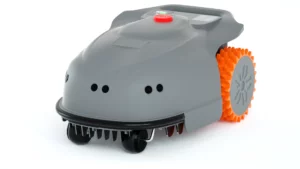








A robot lawn mower’s navigation system determines whether it cuts a straight line, handles trees without getting lost, or confuses a garden hose for a wall. Pick wrong, and you’re shipping a product that generates returns instead of reviews.
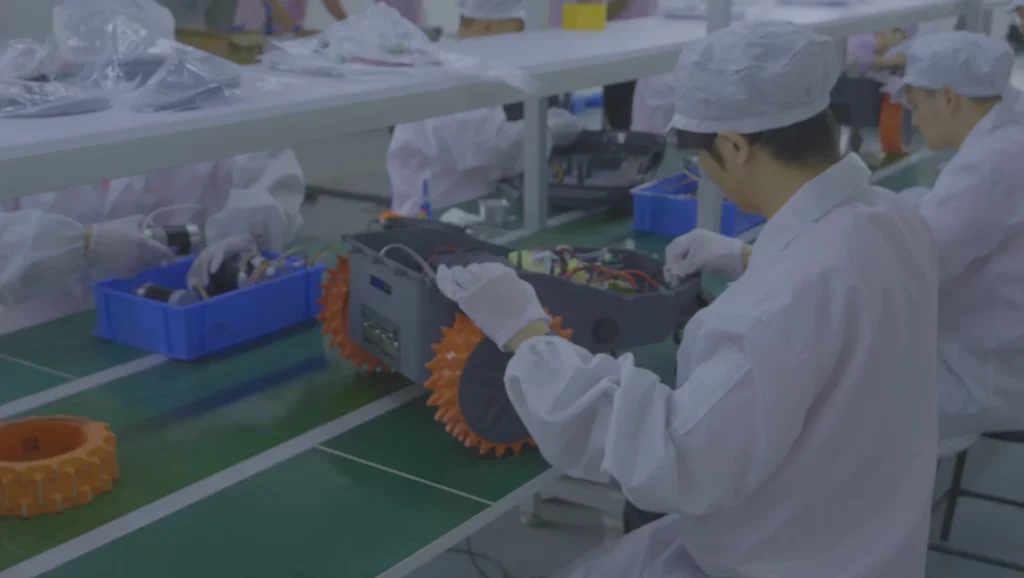
I’ve spent three years testing navigation systems inside robot mower factories. Here’s what actually matters — and what nobody tells you in spec sheets.

How Robot Lawn Mower Navigation Systems Work
Every robot mower needs to answer three questions: where am I, where’s the boundary, and what’s in my way. Three technologies dominate the market in 2026:
RTK (Real-Time Kinematic) GPS navigation for robot mowers
uses satellite positioning corrected by a fixed base station. The base station — a small device you place somewhere with a clear sky view and plug into power — sends real-time correction data to the mower. The mower combines this with its own GPS readings to calculate position within 2 centimeters.
LiDAR robot mower navigation
uses a spinning laser to build a 3D map of the environment. The laser fires pulses in all directions, measures reflection times, and SLAM (Simultaneous Localization and Mapping) algorithms turn that data into a real-time map with the mower’s position inside it.
AI Vision robot mower navigation
uses RGB cameras paired with a neural network processor. The system classifies every pixel it sees — grass, pavement, flower bed, tree, toy, hose — and navigates based on what it recognizes. No laser, no external signals, just cameras and deep learning. Here’s the snapshot:
| Cecha | RTK GPS Robot Mower | LiDAR Robot Mower | Robot-kosiarka AI Vision |
| Positioning accuracy | ±2 cm | ±3-5 cm | ±5-10 cm |
| Boundary type | Virtual (software) | Physical + virtual | Physical + virtual |
| Performance under trees | Degrades | Doskonały | Good (needs light) |
| Night operation | Tak | Tak | No (without IR) |
| Rain performance | Unaffected | Light rain OK | Degraded |
| BOM cost increase | $80-150 | $200-400 | $40-80 |
| User setup | Simple (plug in base station) | Prosty | Prosty |
Now let’s get past the table.
RTK GPS Navigation for Robot Lawn Mowers: Precision and Limitations
RTK has led the Chinese robot mower market since 2021. When the sky is open, nothing beats its price-to-precision ratio.
How RTK GPS Robot Mower Navigation Works
Standard GPS gives you 2-5 meters of accuracy. That’s useless for cutting a straight edge. RTK fixes this with a base station — a compact unit you place outdoors with a clear view of the sky, plug into power, and forget about. The base station calculates GPS signal errors in real time and sends corrections to the mower over radio (LoRa at 868/915 MHz or 2.4 GHz).
The mower’s U-blox F9P or ZED-F9R receiver combines these corrections with its own satellite data. Result: ±2 cm accuracy. Setup takes about 10 minutes. The base station stays where you put it. No ongoing maintenance.
Advantages of RTK Robot Lawn Mowers
The core strength is absolute positioning. The mower knows exactly where it is at all times — not relative to a tree it saw 30 seconds ago, but in real-world coordinates. This enables several things that other systems do less well:
1. Virtual boundaries that just work
Draw a boundary on your phone app, and the mower stays inside it. No perimeter wire, no physical markers. Multi-zone management is straightforward: the mower navigates between separated lawn areas without confusion because each zone has absolute coordinates.
2. Straight-line accuracy you can measure
On a 2,000 m² open test lawn in Dongguan, RTK mowers held a mean boundary deviation of 1.8 cm over three hours. The edges looked machine-cut — because they were.
3. Consistent performance on open terrain
American suburbs. Australian backyards. Middle Eastern villa lawns. Sports fields. Parkland. Anywhere the sky is visible, RTK delivers.
4. Simple user setup
Place the base station somewhere with sky view, plug it in, done. Most users complete setup in under 15 minutes. There’s no perimeter wire to bury, no mapping run to perform, no training period.
RTK Robot Mower Limitations
Trees. GPS signals — even RTK-corrected — degrade under leaf canopy. Our testing on lawns with varying tree cover:
- Open lawn (0% cover): ±1.8 cm, zero drops in 3 hours
- Light trees (20-30% canopy): ±4-8 cm, 2-3 brief drops per hour
- Heavy trees (50%+ canopy): ±15-30 cm, mower may pause or drift every 15-20 minutes
For a brand selling into Northern Europe or the Pacific Northwest — mature trees everywhere — this matters. For Arizona, Dubai, or Perth, it barely registers.
Also worth noting: GPS signals are weak near tall buildings and in narrow urban courtyards. If your target customer has a small walled garden in a city center, RTK isn’t the best fit.
LiDAR Navigation for Robot Lawn Mowers: All-Environment Performance
LiDAR is the most capable navigation technology available for robot mowers. It’s also the most expensive — which is why it lives in premium products above $2,000 retail.
How LiDAR Robot Mower Navigation Works
A 360° LiDAR unit sits on top of the mower, spinning and firing laser pulses — up to 300,000 measurements per second. Each pulse bounces off whatever it hits and returns. The system builds a 3D point cloud of trees, walls, furniture, hedges, and terrain contours in real time.
This is fundamentally different from RTK. LiDAR doesn’t just know GPS coordinates — it knows the shape of everything around it. A SLAM algorithm tracks the mower’s position relative to these shapes. The environment itself becomes the reference frame.
Advantages of LiDAR Robot Mowers
1. Works under dense trees, at night, in any light
The laser generates its own signal. It doesn’t care about satellite visibility or ambient light. For Scandinavian lawns shaded by birch trees, or properties where night mowing is preferred, LiDAR delivers when RTK and vision can’t.
2. Real-time mapping with zero setup
Place the mower on an unfamiliar lawn, press start, and it builds the map as it mows. No base station, no pre-mapping, no teaching boundaries. Commercial mowing services that work across dozens of properties love this.
3. Superior obstacle handling
Because LiDAR sees 3D geometry, it distinguishes a hedge (penetrable, green) from a wall (solid, stop) from a lawn chair (movable, go around). Vision systems sometimes confuse these. RTK doesn’t see them at all.
Our factory test on a 500 m² lawn with 40% tree cover: a Slamtec RPLIDAR S2-equipped mower finished in 52 minutes with zero interventions. The RTK unit on the same lawn needed manual recovery three times.
LiDAR Robot Mower Limitations
1. Cost
A 360° LiDAR sensor runs $150-300 at OEM volumes (Slamtec, Yujin, Leishen). You also need a heftier processor for SLAM — a Rockchip RK3588 or Qualcomm QCS6490 at $40-70 versus a $15-25 MCU for RTK math. Total BOM premium: roughly $200-400 over a baseline RTK system.
2. Mechanical durability questions
A spinning laser turret on a device that lives outdoors, vibrates, and bumps into things. Solid-state RTK receivers and fixed cameras don’t face this problem. Expect 3-5 years before bearing wear affects scan quality under commercial use.
3. Empty spaces confuse it
On a large, perfectly flat, featureless lawn — no trees, no walls, no objects — LiDAR has nothing to localize against. Accuracy drifts to 20-50 cm on lawns over 1,000 m². This is the exact opposite of RTK, which thrives in open space.
4. Heavy rain reduces range
Light rain is fine. Downpours and thick fog cut effective range by 40-60%. The mower still works — it just slows down.
AI Vision Navigation for Robot Lawn Mowers: Smart and Cost-Effective
Vision navigation went from irrelevant to competitive in about two years. The 2024 arrival of affordable edge AI processors changed the economics.
How AI Vision Robot Mower Navigation Works
One to four RGB cameras — typically Omnivision or Sony IMX sensors at 2-8 MP — feed into an NPU (Neural Processing Unit) running object detection and semantic segmentation models at 10-30 frames per second.
The system classifies every pixel: grass here, pavement there, flower bed on the left, child’s toy straight ahead. Navigation decisions flow from those classifications. Meanwhile, visual odometry — tracking features across consecutive frames — gives the mower a continuous sense of motion and direction.
Think of a vision mower as watching the ground pass beneath it, frame by frame.
Advantages of Vision Robot Lawn Mowers
1. Cost leadership
A full vision stack — two cameras, NPU, PCB — adds $40-80 to BOM at OEM quantities. That’s roughly half of RTK and one-quarter of LiDAR. For brands competing at $500-800 retail, vision makes the margin math work.
2. Object recognition, not just detection
LiDAR tells you something is in the way. Vision tells you what it is — a hose, a toy, a sleeping cat. This distinction matters for false stops, which are the #2 consumer complaint about robot mowers (after boundary failures).
3. No external hardware
No base station, no perimeter wire, no subscription. The entire navigation system lives inside the mower. For brands that sell direct to consumers, this eliminates a major source of setup-related support calls.
4. Gets better with software updates
RTK accuracy is bounded by satellite physics. LiDAR range is bounded by laser power. Vision improves when you ship a firmware update with a better model. A 15% improvement in obstacle detection can arrive as an OTA update — no hardware change needed.
Vision Robot Mower Limitations
1. Needs light
At dusk, under heavy shade, on grey winter days — performance drops. IR illuminators and LED headlights help, but they add cost and drain the battery faster. In our tests, a vision system without IR drove straight into a dark garden edge at twilight.
2. Accuracy ceiling
The best vision-only systems hold ±5-8 cm in good conditions. Acceptable for most lawns. Noticeable on formal gardens or if your brand promises “perfect stripes.”
3. Training data bias
A model trained on European lawns (green grass, defined edges, standard garden objects) will struggle in Dubai (sand-colored grass, no defined edges, unfamiliar plants). We tested a European-trained system in Guangdong: it classified a banana plant as an impassable obstacle. Region-specific training data fixes this, but that’s an engineering investment not every brand can make.
Robot Lawn Mower Navigation Comparison: RTK vs LiDAR vs Vision
Let’s put them side by side across the criteria that matter for product decisions:
| Decision Factor | RTK GPS | LiDAR | AI Vision |
| Accuracy on open lawns | ★★★★★ | ★★★☆☆ | ★★★☆☆ |
| Accuracy under trees | ★★☆☆☆ | ★★★★★ | ★★★★☆ |
| Night operation | ★★★★★ | ★★★★★ | ★☆☆☆☆ |
| Rain performance | ★★★★★ | ★★★☆☆ | ★★☆☆☆ |
| Obstacle recognition | ☆☆☆☆☆ | ★★★★☆ | ★★★★★ |
| Setup simplicity | ★★★★☆ | ★★★★★ | ★★★★★ |
| BOM cost (more = cheaper) | ★★★☆☆ | ★☆☆☆☆ | ★★★★★ |
| Large lawn capability | ★★★★★ | ★★★☆☆ | ★★★★☆ |
| Slope handling | ★★★★★ | ★★★☆☆ | ★★★☆☆ |
| Durability (no moving parts) | ★★★★★ | ★★★☆☆ | ★★★★★ |
A few notes on this table, because star ratings hide nuance:
RTK wins on open lawns and slopes. GPS positioning doesn’t care about terrain angle — a 40% slope is the same to a satellite as flat ground. LiDAR and vision systems can lose tracking when the ground plane tilts sharply because their reference frame shifts.
LiDAR wins on versatility. It’s the only system that works reliably in all lighting conditions and under heavy tree cover. If your customers have varied properties, LiDAR covers the most scenarios with the fewest compromises.
Vision wins on object intelligence. A LiDAR mower stops for an obstacle because something is there. A vision mower stops because it knows what is there. That difference translates to fewer false stops and a smoother user experience.
Hybrid Robot Mower Navigation: Combining Two or Three Systems
The best robot mowers in 2026 don’t pick one technology. They pick two — and increasingly, three.
RTK + Vision (The Market Standard Hybrid)
This has become the default configuration for mid-to-premium robot mowers. RTK handles positioning and boundary keeping. Vision adds obstacle recognition and fills the gap when RTK signals weaken under trees. In our testing, an RTK+Vision hybrid held ±3 cm across all conditions — including the 50% tree cover scenario where pure RTK drifted to ±15-30 cm. BOM premium over RTK-only: $100-150.
RTK + LiDAR + Vision (Commercial-Grade Triple Mode)
For large commercial properties — golf courses, public parks, hotel complexes — a triple-mode system runs all three technologies simultaneously. A sensor fusion layer weights each input in real time: RTK dominates in the open, LiDAR takes over under trees, vision handles object classification throughout. On a 5,000 m² mixed-terrain test site, the triple-mode configuration needed zero interventions over a 4-hour run compared to 1-2 for RTK+Vision. The BOM premium is $280-380, but for commercial operators billing by the hour, the reliability pays back within a season.
How to Choose the Best Robot Lawn Mower Navigation System for Your Brand
After testing 40+ configurations, here’s the decision logic:
Pick RTK GPS
If your customers have open lawns above 500 m². Virtual boundaries and multi-zone management are selling features. Target retail: $800-1,800. Best for mid-range residential brands, sports field mowers, large property specialists.
Pick LiDAR
If your brand competes on reliability in any environment. Your customers have tree-covered properties. Night mowing matters. Target retail: $2,000+. Best for premium residential, commercial mowing services, golf maintenance.
Pick AI Vision
If price is the primary competitive dimension. Your customers have smaller, well-lit lawns. You have software engineering capability. Target retail: $500-1,200. Best for entry-level brands, DTC startups, private-label sellers.
Pick a dual hybrid
If your market conditions vary widely — some open, some treed. You want to compete on reliability. Target retail: $1,200-2,500.
Pick triple-mode
For professional-grade commercial equipment where downtime directly costs money. Target market: municipal contracts, landscaping fleets, large commercial properties.
Future Trends in Robot Mower Navigation Technology
Solid-state LiDAR prices are dropping
Flash LiDAR modules from automotive suppliers could hit $50-80 at volume by late 2027. At that price, LiDAR becomes viable for mid-range mowers.
Transformer-based SLAM
Transformer-based SLAM is replacing particle-filter SLAM. Early implementations show 25-35% accuracy gains in complex environments. Qualcomm’s QCS6490 and MediaTek’s Genio 1200 have the NPU headroom to run these models on-mower in real time.
Cellular RTK corrections
Cellular RTK corrections (4G/5G) are eliminating local base stations. Services like Swift Navigation deliver corrections over cellular at $5-15/month. This means RTK accuracy without any hardware to install — though now there’s a subscription to manage.
The Bottom Line
RTK GPS is the best robot lawn mower navigation system for open lawns — unmatched accuracy at a reasonable cost, with straightforward setup.
LiDAR is the best for challenging environments — trees, darkness, and complex properties where other systems struggle.
AI Vision is the best for cost-sensitive products — and it’s improving faster than the other two.
The smartest approach for most brands in 2026: an RTK+Vision hybrid. RTK for positioning precision, vision for obstacle intelligence. You get the strengths of both without the full cost of LiDAR.
Your customers’ lawn type, your price point, and your engineering resources should drive the decision. There’s no universal best robot mower navigation system — only the one that fits your product.
Altverse manufactures robot lawn mowers across all three navigation platforms — RTK, LiDAR, vision, and hybrid configurations — for OEM/ODM brands worldwide. Talk to our team about which navigation system fits your product →
Często zadawane pytania
What is the best robot lawn mower navigation system for lawns with trees and shade?
LiDAR is the best robot lawn mower navigation system for lawns with dense trees and shade. Unlike RTK GPS, LiDAR does not rely on satellite signals and maintains reliable positioning under heavy canopy, at night, and in complex environments. For mixed open and shaded lawns, RTK + Vision hybrids are a popular alternative.
Do robot lawn mowers need a perimeter wire?
No. Most modern robot lawn mowers use wire-free navigation. RTK GPS models rely on virtual boundaries, LiDAR models create real-time maps, and AI vision systems identify lawn edges with cameras. Perimeter wires are now mainly found on entry-level models.
How accurate are RTK, LiDAR, and AI vision robot mowers?
RTK GPS provides the highest positioning accuracy at approximately ±2 cm. LiDAR typically achieves ±3–5 cm while maintaining performance under trees. AI vision systems deliver around ±5–8 cm in good lighting conditions and are suitable for most residential lawns.
Can robot lawn mowers work at night?
Yes, but it depends on the navigation technology. RTK GPS and LiDAR robot mowers operate normally in darkness. AI vision systems require sufficient lighting or infrared support to maintain obstacle detection and navigation performance.
Which is better: RTK GPS or AI vision navigation?
RTK GPS offers higher accuracy, better large-lawn performance, and reliable operation in rain and darkness. AI vision costs less, requires no external hardware, and provides superior obstacle recognition. Many leading robot lawn mowers now combine RTK and vision to leverage the strengths of both technologies.
What is the best navigation system for robot lawn mower brands in 2026?
For most residential robot mower brands, RTK + Vision hybrid navigation offers the best balance of accuracy, obstacle avoidance, cost, and reliability. LiDAR remains the premium choice for complex environments, while AI vision is the most cost-effective option for entry-level products.
Przekształć swoją wizję kosiarki zrobotyzowanej w produkcję
Niestandardowe OEM/ODM produkcja - PCBA, montaż i logistyka od jednego partnera.
- Szybki czas realizacji od projektu do dostawy
- Zaufanie marek na całym świecie
- Bezpłatny przegląd DFM przed podjęciem decyzji
- Dedykowany inżynier w ciągu 24 godzin

Ekspert w dziedzinie robotyki, pasjonat odkrywania szerokiej gamy robotów, robotów, które sprawiają, że praca jest bardziej wydajna, odkrywania robotów, w tym robotów mobilnych, robotów kosiarek.