
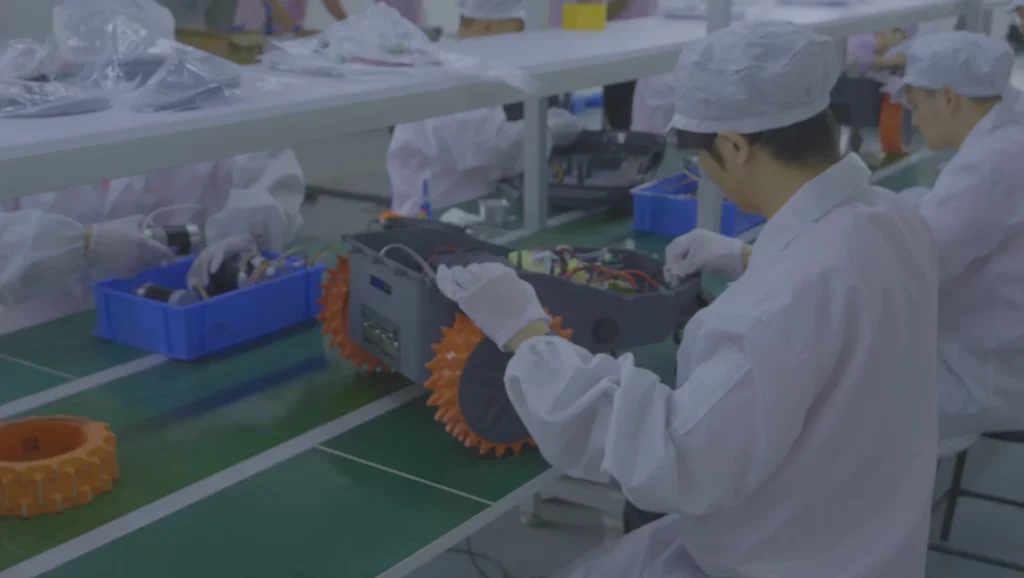








If you’re a brand owner, an OPE (Outdoor Power Equipment) manufacturer, or an entrepreneur looking to enter the rapidly growing residential robot lawn mower market, China is — without question — your best OEM/ODM destination. But let’s be honest: the robot lawn mower OEM/ODM industry is deep water. Finding a factory is easy. Finding a trustworthy one — a factory that delivers consistent quality, doesn’t poach your customers, and protects your intellectual property — requires a systematic, battle-tested methodology.
This article is written for you. It takes the full robot lawn mower OEM/ODM journey — from factory sourcing, negotiation, and sampling to mass production and international shipping — and breaks it down completely, with nothing left out.

Why Choose China for Robot Lawn Mower OEM/ODM Manufacturing?
The global robot lawn mower market was valued at approximately $1.5 billion in 2025 and is projected to surpass $4.8 billion by 2032, growing at a CAGR exceeding 17%. The core supply chains of virtually every leading robotic mower brand run through China.
In other words — regardless of what brand of robot lawn mower you buy in Europe or the US, its motor, PCBA board, battery pack, and often the entire assembled unit most likely came from China. This is a thoroughly validated industrial reality, not speculation.
How Mature Is China’s Robot Lawn Mower Supply Chain?
Five years ago, many people’s impression of “made in China” was still stuck at low price and low quality. But the situation today is completely different:
- Navigation Systems: Chinese factories now mass-produce centimeter-level RTK GPS, 360° LiDAR, and deep-learning visual SLAM — with technical specifications on par with premium European brands.
- Motor Systems: Brushless DC hub motor (BLDC Hub Motor) lifespan exceeds 2,000 hours, and 4WD climbing capability reaches 35° and above.
- Battery Systems: Lithium Iron Phosphate (LiFePO₄) and NMC lithium options are available, equipped with intelligent BMS that delivers automotive-grade safety and cycle life.
- PCBA & Firmware: Embedded Linux/RTOS platforms support OTA remote upgrades, multi-zone scheduling, and AI-powered visual obstacle avoidance.
How Much Does Robot Lawn Mower OEM/ODM Manufacturing Cost?
The figures below are based on our actual Q1 2026 quotations (FOB Shenzhen/Ningbo), cross-validated with European and North American clients:
|
Product Category |
China OEM Price (FOB) |
US / EU Equivalent |
Poupança |
|
Entry-Level (Perimeter Wire Boundary) |
$250 – $400 |
$600 – $1,000 |
50 – 60% |
|
Mid-Range RTK (Virtual Boundary) |
$500 – $800 |
$1,200 – $2,500 |
55 – 65% |
|
High-End AI Vision (RTK + Vision) |
$900 – $1,500 |
$2,500 – $5,000 |
60 – 70% |
|
Injection Mold Tooling (Full Shell Set) |
$15,000 – $50,000 |
$50,000 – $150,000 |
65 – 70% |
Please note: The above are FOB (Free On Board) prices. Your actual landed cost must also include ocean freight, import duties, and certification fees. But even with all of those added, the total cost advantage compared to developing locally in Europe or the US remains in the 40–60% range. Anyone who has done a hardware startup will not doubt this for a second.
How Fast Can You Launch a Robot Lawn Mower from China?
This is a timeline we have validated repeatedly:
- ODM model (factory’s existing turnkey platform + your brand customization): First contact → container shipment = 3–5 months
- OEM model (your design + factory contract manufacturing): First contact → mass production = 6–12 months
- Developing from scratch in the US or Europe: Typically 18–36 months, with R&D costs at least doubled
Behind this speed difference is a large-scale consumer electronics contract manufacturing ecosystem that China has refined for over a decade — an ecosystem that is extremely difficult to replicate in any other country in the short term.
→ Deep dive: Global Robotic Lawn Mower Manufacturers — Top 10 Ranking (2026)
OEM vs. ODM Robot Lawn Mowers: What’s the Difference and Which Model Fits Your Brand?
Frankly, many clients don’t have a clear picture of how OEM and ODM actually differ when they first speak with us. That’s perfectly normal — but this question must be settled first, because it directly determines your budget, timeline, product differentiation, and IP ownership.
What Is OEM (Original Equipment Manufacturing) for Robot Lawn Mowers?
Under the OEM model, you are the product owner. You provide the industrial design drawings, PCBA schematics, firmware requirement documents, and BOM (Bill of Materials). The factory’s role is “manufacturing executor” — providing production lines, workers, quality control, and assembly.
|
OEM Advantages |
OEM Challenges |
|
Fully differentiated product — hard for competitors to imitate |
Higher upfront investment, typically $100K – $500K |
|
You own 100% of the intellectual property and design rights |
Longer cycle, generally 6–12 months |
|
Stronger brand moat, larger profit margins |
You need your own R&D team or outsourced design partner |
|
Once successful, the competitive moat is very deep |
Stricter MOQs, typically 500–1,000 units to start |
Best suited for?
Established OPE brands with in-house R&D capability; companies pursuing a unique industrial design and aiming to build an “instantly recognizable” brand in a crowded market; brands projecting annual sales above 5,000 units with sophisticated product cost management needs.
What Is ODM (Original Design Manufacturing) for Robot Lawn Mowers?
Under the ODM model, the factory has already completed the core product R&D and engineering validation. You select a product from this existing turnkey platform, customize the brand elements — logo, color scheme, packaging, app UI — and bring it to market fast.
|
ODM Advantages |
ODM Challenges |
|
Low upfront investment, typically $5K – $30K to get started |
Limited product differentiation — the same platform may be sold to multiple brands |
|
Extremely fast — 3–5 months to ship |
You don’t own the core IP — hardware and software belong to the factory |
|
No R&D team needed — the factory provides full technical support |
Higher dependency on the factory — upgrades and optimization require factory cooperation |
|
Flexible MOQ, typically 50–200 units |
Intense price war pressure — competitors may sell the same product |
Best suited for?
Brand entrepreneurs, Amazon top sellers, and DTC (direct-to-consumer) brands; companies wanting to test the market with a small batch first; private label programs for large retailers; OPE dealers and distributors looking to launch their own label brand.
OEM vs. ODM Robot Lawn Mower: How to Choose?
Question 1: Do you have your own R&D team?
Yes → Consider OEM. No → ODM is your pragmatic first step. Validate the market first, then consider OEM development once you have traction.
Question 2: How does your brand compete?
On price and distribution channels → ODM is fine. On unique features, design, or technology → You need OEM.
Question 3: What’s your budget? How fast do you want to launch?
Budget under $50K, want to launch within 6 months → ODM. Budget above $100K, with 12+ months of patience → OEM.
Our advice: Many successful brands started with ODM — launch quickly to test market response, build sales channels and brand awareness, then reinvest into OEM for proprietary products. This is a lower-risk, more pragmatic path.
→ Deep dive: ODM vs. OEM Robot Lawn Mowers — Which Model Fits Your Brand in 2026?
How to Find Reliable Chinese Robot Lawn Mower Factories (Without Getting Burned)?
On Reddit and LawnSite forums, the most frequently asked question is “How do I avoid getting ripped off?” The truth is, about 80% of the pitfalls in this industry are seeded at the factory selection stage. But flip it around — as long as you do factory vetting properly at this stage, the problems downstream will basically not be major ones.
Where to Find Chinese Robot Lawn Mower Manufacturers?
|
Channel |
Melhor para |
Watch Out For |
|
Alibaba.com |
Initial screening, quickly obtaining quotations |
Many trading companies posing as factories — verification is essential |
|
Made-in-China.com |
Industrial / technology-oriented suppliers |
Buyer protection mechanisms not as mature as Alibaba’s |
|
Canton Fair (April / October, Guangzhou) |
Face-to-face communication, seeing products in person |
Requires travel; some exhibitors won’t take small orders |
|
Equip Expo (October, Louisville) |
Finding manufacturers with existing US operations |
Limited number of Chinese exhibitors |
|
Industry referrals / word of mouth |
Highest-quality lead source |
Hard to access without existing industry connections |
|
Google / LinkedIn search |
Finding factory websites directly |
Many factories have poor English SEO — hard to discover via search |
How to Tell a Real Robot Lawn Mower Factory from a Trading Company?
This is the eternal pain point in international sourcing. Below is our five-step verification method, each step field-tested:
Step 1 — Check the Business License.
The “business scope” on the license must include “manufacturing”; it cannot only list “trading” or “wholesale.”
Step 2 — Request a Live Video Factory Tour.
A real factory can take you on a video tour of the production floor at any time. If the other party hesitates and says “not convenient” or “next time” — this is a massive red flag. During the Zoom call, pay attention to: Are the production lines running? Are workers actively operating? Are materials flowing?
Step 3 — Welcome On-Site Visits.
Even if you can’t go yourself, a robot lawn mower factory that actively invites you for an on-site visit is itself a positive signal. You can commission a third-party inspection company (such as SGS, TÜV, or Bureau Veritas) to visit on your behalf.
Step 4 — Verify Export Records.
Request recent Bill of Lading samples (sensitive information can be redacted). A factory that can provide real US or Europe B/Ls has demonstrated familiarity with export procedures and compliance requirements. You can also check the factory’s export records through customs data platforms.
Step 5 — Cross-Verify Certification Credentials.
The ISO 9001, BSCI, CE reports, etc. that a robot lawn mower factory claims — don’t just look at photos. Ask for certificate numbers, then independently verify them on the certification body’s official website. We’ve seen plenty of cases where people were deceived with Photoshopped certificates.
10-Point Robot Lawn Mower Manufacturer Evaluation Checklist for OEM/ODM Buyers
We break this checklist down in detail in a dedicated article. Here is the summary framework:
- Production Capacity — Monthly output? How many assembly lines? Peak-season surge capacity?
- R&D Team — How many engineers? In-house R&D or outsourced design?
- Quality Certifications — Are ISO 9001, BSCI, and product-level CE/FCC/UL certifications all in place?
- Existing Clients — Which brands have they manufactured for? Can they provide reference letters?
- Non-Compete Commitment — Are they willing to sign a non-compete clause?
- Communication Capability — English proficiency of the contact person? Response speed (we recommend testing 24-hour reply rate)?
- MOQ Flexibility — What is the first-order minimum quantity? Do they accept a “small trial + larger follow-up” model?
- After-Sales Support — Are warranty terms, spare parts supply, and RMA (return merchandise authorization) processes clearly defined?
- Intellectual Property Protection — Will they sign an NDA? Any history of IP disputes?
- Financial Stability — Years in operation? Is the factory owned or leased?
→ Deep dive: Complete 10-Point Robotic Lawn Mower OEM/ODM Manufacturer Evaluation Checklist
Will Your Robot Lawn Mower Factory Compete Against You?
This concern does not come from nowhere. In multiple product categories, there have indeed been cases where Chinese robot lawn mower contract manufacturers launched their own brands and cannibalized their original clients. Below are the core protective measures we recommend:
① Non-Compete Clause in the Contract:
Explicitly prohibit the factory from selling identical or substantially similar products — in any form (own brand, joint venture, OEM for other brands) — within the contractually defined territory. This is not an optional clause; it is the cornerstone of the entire cooperation relationship.
② Mold Ownership Rights:
Any mold you pay to develop must be 100% your property. The contract must state: molds shall not be used for producing products for other clients, and upon termination of cooperation, you have the right to demand their return or destruction.
③ Chinese Design Patent :
During the product design phase, file a Chinese design patent (application cycle approximately 6–8 months). It is not expensive, but can effectively block counterfeiting at the legal level.
④ Firmware Encryption Lock:
Customize the firmware with an encryption key so that only your app or cloud can unlock the core functions. This way, even if someone gets hold of the hardware, they can’t use it without your key.
Key Takeaway:
Core principle: Trust is important, but contract terms are more reliable than trust. A factory worth building a long-term relationship with will not refuse reasonable non-compete clauses.
→ Deep dive: How to Choose a Non-Competing Robot Lawn Mower OEM/ODM Manufacturer
Robot Lawn Mower OEM/ODM Development Process: Step-by-Step from Concept to Shipment
Understanding the development process helps you set realistic timelines and budgets. Below is the complete path for a typical ODM project — for OEM projects, you can estimate by multiplying the cycle by 2–3×.
|
Phase |
Core Activities |
Timeline |
|
Phase 1: |
Define product specifications (cutting width, coverage area, navigation method, battery capacity, target retail price); shortlist 3–5 factories; sign NDAs; collect and compare quotations; select factory and sign LOI (Letter of Intent) |
Weeks 1–3 |
|
Phase 2: |
Factory provides existing samples; you personally test: cutting performance, navigation accuracy, app experience, build quality; submit feedback and revision requests; factory revises and provides samples again |
Weeks 4–8 |
|
Phase 3: |
Finalize brand elements: logo placement, Pantone color scheme, packaging design; customize firmware UI (app skin, voice prompts, default settings); CE/FCC pre-compliance testing; user manual and packaging sampling |
Weeks 6–12 |
|
Phase 4: |
Small-batch pilot production (50–200 units); comprehensive QC inspection (recommend using SGS or TÜV third-party inspection); shipment sample confirmation; packaging and labeling final verification |
Weeks 10–14 |
|
Phase 5: |
Volume production; pre-shipment AQL sampling inspection; container loading (FOB); customs clearance; delivery to your warehouse |
Weeks 14–20 |
5-Month ODM Robot Lawn Mower Project Timeline at a Glance
- Month 1: Factory selection & contract signing
- Month 2: Sampling & evaluation
- Month 3: Brand customization
- Month 4: Small-batch pilot production & QC
- Month 5: Mass production & shipment
OEM projects typically need to multiply this timeline by 1.5–2× because of the additional custom development and mold fabrication involved.
→ Deep dive: Robotic Lawn Mower OEM/ODM Customization & Development — Complete Step-by-Step Process
Robot Lawn Mower Customization Options: What Can You Actually Customize?
This is the question virtually every first-time ODM client asks. We’ve broken it down into three tiers to make it clear.
Tier 1: Low-Cost Robot Lawn Mower Customizations Available Even in ODM (Fast Turnaround)
|
Customization Category |
What You Can Do |
One-Time Cost |
Timeline Impact |
|
Brand Identity |
Logo silkscreen / laser engraving, brand Pantone colors, nameplate, boot-up screen |
$0 – $2,000 |
+1–2 weeks |
|
Packaging |
Full custom color box, user manual, quick-start guide |
$500 – $3,000 |
+1–3 weeks |
|
App / Firmware |
App skin / theme, in-app brand name, default settings adjustment |
$2,000 – $10,000 |
+2–4 weeks |
|
Acessórios |
Charging station appearance, blade style, protective cover styling |
$1,000 – $5,000 |
+2–4 weeks |
Tier 2: Deep OEM Customizations for Robot Lawn Mowers (Higher Investment, Genuine Differentiation)
|
Customization Category |
What You Can Do |
One-Time Cost |
Timeline Impact |
|
PCBA / Circuit Board |
Full custom circuit design, sensor selection, chipset platform choice |
$20,000 – $80,000 |
+3–6 months |
|
Design industrial |
Complete exterior design — shell, chassis, wheel hub design |
$30,000 – $100,000+ |
+4–8 months |
|
Motor / Drive System |
Custom motor specifications, AWD / RWD / 4WD configuration |
$10,000 – $40,000 |
+2–4 months |
|
Sistema de bateria |
Custom cell selection, BMS firmware, capacity specifications |
$5,000 – $20,000 |
+1–3 months |
Tier 3: Hardware Limitations — What Even OEM Robot Lawn Mower Projects Cannot Change
- Core RTK / LiDAR module specifications (these come from third-party suppliers such as U-blox and Quectel)
- Fundamental safety architecture (this is the baseline for CE/FCC compliance — modifying it means failing certification)
- The lowest-level motor controller firmware (usually locked by the component supplier)
→ Deep dive: Robot Lawn Mower ODM Customization Guide — What You Can and Cannot Customize (2026)
→ Deep dive: How to Customize a PCBA Solution for Robotic Lawn Mowers — From Design to Mass Production
Robot Lawn Mower Bulk Purchasing, Pricing & International Logistics Guide
Robot Lawn Mower MOQ: Minimum Order Quantities by Project Type
|
Project Type |
First Order MOQ (Typical) |
Repeat Order MOQ |
|
ODM (Factory Turnkey Platform) |
50 – 200 units |
100 – 500 units |
|
OEM (New Development) |
500 – 1,000 units |
Per contract negotiation |
|
White-Label (Standard Model, Badge Only) |
20 – 100 units |
50 – 200 units |
Negotiation tip:
First-order MOQ is negotiable — especially if you commit to a larger second order. The “50/200 split” (first order 50 units, with 200 additional units within 90 days) is a common compromise structure.
FOB Pricing for Robot Lawn Mowers: What’s Included and What’s Not
Quotations from Chinese factories are typically FOB (Free On Board). FOB includes: product cost + export packaging + China customs declaration + loading onto the vessel.
FOB does NOT include:
ocean freight (20ft container to the US: $800–$2,500; to Europe: similar), marine insurance (approximately 0.5–1% of cargo value), import duties (US: most robot lawn mower HS codes 0–2.5%; EU: varies by country), destination customs clearance, and inland trucking.
Landed cost quick formula:
FOB price × 1.15–1.25 (US West Coast) / × 1.20–1.35 (US East Coast / EU)
Robot Lawn Mower Shipping Options: Ocean Freight, Air Freight & China-Europe Railway Compared
|
Shipping Method |
Transit Time |
Cost (Estimated) |
Melhor para |
|
Ocean FCL (Full Container Load) |
25–35 days to US / 30–40 days to EU |
$1,500 – $3,000 / 20ft container |
Cargo volume > 10 CBM |
|
Ocean LCL (Less than Container Load) |
30–45 days |
$150 – $300 / CBM |
Cargo volume < 10 CBM |
|
Air Freight |
5–10 days |
$3 – $6 / kg |
Samples, urgent replenishment |
|
China-Europe Railway Express |
15–20 days |
$1 – $2 / kg |
Mid-speed EU delivery |
→ Deep dive: Bulk Robotic Lawn Mower Purchasing Guide — How to Buy Direct from Factories & Negotiate the Best Price
Robot Lawn Mower Certification Guide: US (FCC/UL) & EU (CE/RED) Market Requirements
For robot lawn mowers to legally enter the US and European markets, some certifications are hard requirements, and some are “nice to have but make selling much easier.” Here’s a quick overview — for more detail, please refer to our dedicated certification guide.
US Robot Lawn Mower Certifications: FCC, UL & ANSI Requirements Explained
|
Certificação |
Mandatory / Recommended |
What It Tests |
|
FCC Part 15 |
Mandatory (for products with wireless functions) |
RF emissions, electromagnetic interference |
|
UL 3100 / UL 62841 |
Recommended (Home Depot / Lowe’s / Amazon typically require it) |
Electrical safety, battery safety |
|
ANSI / OPEI B71 |
Recommended (industry standard) |
Mower-specific safety |
|
California Prop 65 |
Mandatory (if sold in California) |
Chemical exposure warning |
EU Robot Lawn Mower Certifications: CE, RoHS, RED & Machinery Directive
|
Certification / Directive |
Mandatory / Recommended |
What It Tests |
|
CE Marking |
Mandatory (all products) |
Comprehensive: safety, EMC, radio (RED) |
|
RoHS |
Mandatory (all electronic products) |
Hazardous substance restrictions |
|
WEEE |
Mandatory (all electronic products) |
Waste electronic equipment recycling compliance |
|
RED 2014/53/EU |
Mandatory (wireless devices) |
Radio Equipment Directive |
|
Machinery Directive 2006/42/EC |
Mandatory (all machinery including mowers) |
Mechanical safety |
Cost-saving tip:
Choosing an ODM factory with a pre-certified platform can save more than 60% on certification costs. A full CE+FCC suite for a brand-new robot lawn mower typically costs $8,000–$20,000 with a 4–8 week cycle. Using a factory’s existing pre-certified platform, you only need delta testing (typically a few thousand dollars and 2–3 weeks).
How to Start Your Robot Lawn Mower OEM/ODM Project?
If you’ve made it this far, you now have a systematic understanding of the China robot lawn mower OEM/ODM model, costs, and processes. The next step is no longer about “information gathering” — it’s about “how to actually get the product built.”
If You’re Ready to Start Your Robot Lawn Mower Project (Recommended Next Steps)
Define Your Product Requirements (The Most Critical First Step)
This includes your target market (Europe / North America / Australia), budget range, feature configuration (RTK, visual obstacle avoidance, slope capability, etc.), and projected sales volume. This directly determines whether you choose the ODM or OEM path.
Connect with a Professional Team for Factory-Product Matching
You can contact Altverse directly for a needs assessment and supply chain matching. Based on your product positioning, budget, and technical requirements, we’ll shortlist suitable robot lawn mower OEM/ODM factories, with non-compete protection safeguards — helping you avoid costly mistakes and wrong factory selections.
Request Samples and Run Comparative Testing
We recommend selecting 2–3 factories simultaneously for sample testing. Evaluate them side by side on cutting performance, navigation stability, battery life, and app experience before making a mass production decision.
Still in the Research Phase? — Recommended Robot Lawn Mower OEM/ODM Reading Roadmap
We recommend going deeper in this order:
① ODM vs OEM Robot Lawn Mowers: Which Model Fits Your Brand?
② Robot Lawn Mower OEM/ODM Factory Evaluation Checklist (10 Key Criteria)
③ Top Chinese Robot Lawn Mower OEM/ODM Manufacturers Analysis (2026)
④ Robot Lawn Mower Development Process: From Design to Mass Production
⑤ How to Choose a Non-Competing OEM Robot Lawn Mower Partner
Need Hands-On Guidance for Your Robot Lawn Mower Project?
If you already have a rough idea (even if it’s just a budget figure or a target market), you can reach out to Altverse directly for a one-on-one project assessment. We can help you quickly determine:
- Whether ODM or OEM is the right fit for your situation
- Whether your target cost structure is realistically achievable
- Which factories and solution paths are the best match for your requirements
- A realistic timeline from concept to mass production
The goal is to help you avoid the trial-and-error path and reach the production-ready stage faster.
Perguntas frequentes
What Wireless Connectivity Options Are Available for Robot Lawn Mower OEM/ODM? (WiFi / 4G / RTK)
Residential robot lawn mower OEM/ODM typically supports WiFi and Bluetooth as basic connectivity; premium models can optionally include a 4G remote control module and RTK high-precision positioning system for boundary-free mowing and remote fleet management. Different wireless schemes directly impact the total unit cost and positioning accuracy.
Can Robot Lawn Mowers Be Pre-Loaded with Maps or Data During OEM/ODM Production?
Yes. Some OEM/ODM solutions support factory preset basic map parameters or default mowing path configurations, but the unit typically needs to re-map after deployment to the actual lawn environment — final mapping is always based on the end user’s on-site setup.
Who Owns the Robot Lawn Mower App and Software in an OEM/ODM Project?
It depends on the cooperation model. Under ODM, the app typically belongs to the factory or runs on a shared platform. Under OEM custom development, app brand ownership and server access rights can be contractually negotiated, though the underlying navigation algorithms are typically still controlled by the supplier.
What Pre-Production Testing Is Required Before Robot Lawn Mower Mass Production?
Pre-production testing typically includes: mowing performance tests, navigation stability tests, slope-climbing tests, rain exposure tests, battery cycle tests, and drop tests — to ensure the robot lawn mower’s reliability across different lawn environments.
Why Do Different Factories Quote Wildly Different Prices for the Same Robot Lawn Mower Specs?
The differences typically come from three hidden factors: BOM component grade (brand and quality of components), software capability (whether the algorithms are mature), and whether the factory is using an existing ODM platform — not just raw manufacturing cost differences.
Transforme a sua visão de cortador de relva robótico em produção
Personalizado OEM/ODM fabrico - PCBA, montagem e logística de um parceiro.
- Rápida execução desde a conceção até à entrega
- A confiança das marcas em todo o mundo
- Análise gratuita do DFM antes de se comprometer
- Engenheiro dedicado em 24 horas

Especialista em robótica, apaixonado por explorar uma vasta gama de robôs, robôs que tornam o trabalho mais eficiente, explorando robôs, incluindo robôs móveis, robôs corta-relvas.


