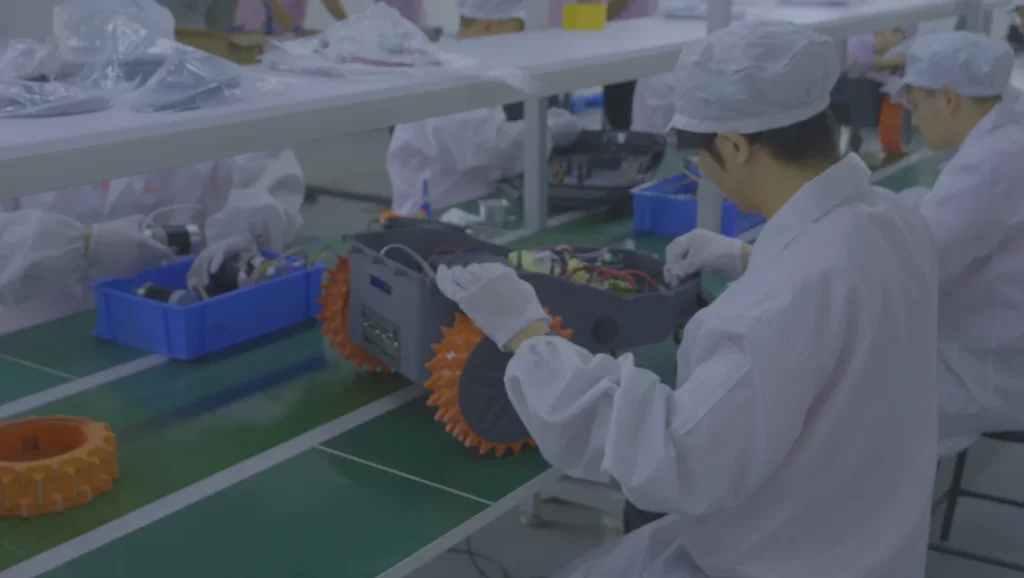









For robotic lawn mower brands and OEM buyers, prototype testing is a critical checkpoint between product development and mass production. A mower that performs well in a lab may still struggle with wet grass, steep slopes, obstructed navigation signals, rain, or extended operation in a real yard.
So, what should be tested before production begins? How do engineering teams run those tests, and what evidence shows that a prototype is ready for the next stage? This guide walks through 10 essential tests using practical scenarios, then explains how to evaluate results, navigate the EVT/DVT/PVT process, and assess an OEM manufacturing partner—even without an engineering background.

Why Is Robotic Lawn Mower Prototype Testing Essential Before Mass Production?
The purpose of prototype testing is to uncover potential problems before a company commits significant resources to tooling, component purchases, and production lines. For example, tall grass may overload the cutting motor; trees may interfere with positioning signals; slopes may cause the wheels to slip; and poorly sealed enclosures may allow water to reach the electronics. Drawings and a successful indoor demonstration cannot fully reveal these risks.
An OEM development team therefore needs to turn functional, performance, safety, and reliability requirements into repeatable test cases, with documented conditions, results, and failures. Prototype testing is the starting point—not a one-time approval for mass production. Open issues must be addressed and rechecked through subsequent engineering validation (EVT), design validation (DVT), and production validation (PVT).
10 Essential Robotic Lawn Mower Prototype Tests Before Mass Production
The following tests cover cutting performance, autonomous navigation, outdoor durability, and long-term reliability. The exact methods and acceptance criteria depend on the mower’s specifications, navigation technology, and intended markets. These examples illustrate what to evaluate and how to evaluate it; they are not a universal test standard for every model.
1. Cutting Performance Test
Cutting quality is one of the first things end users notice. A robotic mower should do more than shorten grass: it should deliver reasonably even results as grass height, density, and moisture change, while minimizing missed patches, clogging, and unexpected shutdowns. For a brand, poor cutting results can quickly turn into negative reviews and higher support costs.
Engineers typically prepare test areas with different grass types, heights, and densities, then repeat mowing runs at a defined cutting height, travel speed, and battery state. They record the time required to cover a set area, grass height before and after mowing, missed spots, cutting-motor current, operating temperature, and energy consumption. Tall or wet grass deserves particular attention because it can cause poor discharge, grass buildup, or motor overload.
Passing the test is not just about achieving a neat finish once. Results should remain consistent across repeated runs. If the mower regularly stalls under heavier loads, the team should examine the cutting deck, motor selection, or control strategy, make the necessary changes, and retest under comparable conditions.
2. Navigation Accuracy Test
Navigation determines whether a mower can locate itself, identify where it needs to cut, and find its way back to the charging station. Real yards may have walls, tree cover, narrow passages, and irregular boundaries. A successful demonstration on an open lawn does not necessarily prove that the navigation system will work reliably in those settings.
Testers can establish repeatable routes across open areas, partially obstructed lawns, and multi-zone yards. They assess positioning error, boundary tracking, missed coverage, unnecessary repeat passes, and successful returns to the dock. RTK, vision-based, and other navigation approaches also require tests tailored to their limitations, such as blocked satellite signals, changing light, low-feature environments, or communication interruptions.
Each scenario should be repeated, with failures recorded and investigated. If the mower loses confidence in its position, its ability to pause safely, regain localization, or guide the user through recovery is part of the test—not something that should be left out of the results because the task was not completed.
3. Obstacle Detection and Safety Test
Pots, toys, branches, and other temporary objects can appear on a lawn at any time. People or pets may also enter the mowing area. The purpose of obstacle detection is to help the mower recognize its surroundings and respond as designed—by slowing down, stopping, or changing course—to reduce collisions and hazardous contact.
Engineers place stationary objects of different sizes, colors, materials, and heights in controlled test areas, then simulate moving obstacles using safe test fixtures. By varying lighting, backgrounds, and approach angles, they can examine detection distance, response behavior, and false detections. Where relevant, they also check how vision systems and contact sensors handle objects the camera may fail to recognize.
AI-based detection is not a substitute for dedicated safety functions. Lift-triggered blade shutdown, tilt protection, emergency-stop behavior where provided, blade guarding, and safe responses to faults must be evaluated against the product requirements and applicable market standards. Potentially hazardous tests should be conducted with proper safeguards—not with real children or animals.
4. Battery and Charging System Test
Battery runtime determines how much mowing a robot can complete per session. Reliable automatic docking determines how often its owner has to intervene. Actual runtime varies with grass density, slope, temperature, and route efficiency, so a light-duty endurance run on its own gives an incomplete picture.
Prototype testing should measure operating time, energy use, and battery temperature under ordinary mowing, heavy cutting loads, and sloped-terrain conditions. Engineers also trigger returns to the charging station at different remaining charge levels and observe navigation to the dock, contact alignment, and task resumption. Charging checks include voltage, current, temperature management, behavior after power interruptions, and battery management system (BMS) protections.
Longer-term plans should include charging and discharging cycles followed by capacity checks. If runtime varies significantly or docking fails too often, the team may need to investigate energy-management settings, charging contacts, positioning logic, or battery selection.
5. Waterproofing and Outdoor Reliability Test
Robotic lawn mowers are routinely exposed to dew, rain, mud, and dust. Water ingress can do more than stop the machine: it can affect the safety and service life of the battery, drive motors, control board, and charging connectors. Outdoor protection therefore needs a measurable design target, not simply an enclosure that appears well sealed.
Engineers choose appropriate ingress protection (IP) tests based on the product’s target rating, paying close attention to housing joints, buttons, cable entries, battery compartments, and charging interfaces. After water-spray or dust tests, they inspect internal components and repeat key functional checks, including startup, driving, charging, and sensor operation. Exposed components may also need humidity or corrosion-risk testing, depending on their intended conditions of use.
Importantly, an IP rating is not the same as permission to mow in any weather. Whether the product can operate during heavy rain, standing water, or cleaning procedures must be defined by its actual design specifications and user instructions—not inferred from the rating alone.
6. Slope and Terrain Adaptability Test
Residential yards can include long inclines, short steep banks, ruts, uneven ground, and slippery grass. Insufficient traction may leave a mower stuck or sliding, while poor weight distribution or inadequate motion control may increase the risk of tipping.
Testing can cover different gradients, slope lengths, and surface conditions, with separate runs for climbing, descending, turning, starting on a slope, and recovering after an unexpected stop. Engineers record wheelspin, slipping, underside contact, and activation of tilt or attitude-protection functions. Wet grassy slopes deserve separate attention because grip can be very different from that on dry ground.
The outcome should be a realistic specification of supported terrain and operating limits, rather than a marketing claim based on a single extreme climbing attempt. The same results can guide improvements to tire tread, ground clearance, and drive-control algorithms.
7. Mechanical Reliability Test
Wheels, cutting assemblies, bearings, fasteners, and housing joints are exposed to repeated starts, stops, vibration, and impacts. A new prototype may run smoothly but later develop rattles, loose fasteners, excessive wear, or declining performance as mechanical stresses accumulate.
Mechanical validation typically includes wheel endurance runs, repeated start-stop cycles, controlled vibration tests, transport simulation, and inspections of critical joints. Engineers compare component wear, clearances, noise, and operation before and after testing. Cutting assemblies also require checks for secure attachment, abnormal vibration, and protective responses under specified operating conditions.
When a part loosens or wears prematurely, replacing it is not enough. The team should trace the failure back to materials, assembly tolerances, fastening methods, or load paths. That root-cause work turns a prototype failure into a more robust design for production.
8. Software and Mobile App Test
Customers use a mobile app to set up maps, mowing schedules, no-go zones, and fault notifications. Software reliability matters just as much as mechanical performance: frequent disconnections, failed setup attempts, or lost schedules can undermine an otherwise capable mower.
Testing should cover initial pairing, multiple-device access, changes to scheduled tasks, network interruptions, power cycling, fault alerts, and over-the-air (OTA) updates. Particular attention should go to recovery after an interrupted update and to whether the mower remains in a safe state when disconnected, retains necessary settings, and synchronizes correctly when the connection returns.
OEM brand projects should also consider language support, access permissions, data protection, and compatibility with relevant mobile operating systems. Key user journeys are best tested from start to finish, rather than checking individual app buttons in isolation.
9. Aging and Long-Term Reliability Test
Passing a short functional test does not guarantee dependable performance over several mowing seasons. Battery capacity loss, motor wear, seal degradation, and electronic faults may emerge only after repeated use or changing environmental conditions.
A reliability program may combine extended mowing cycles, repeated docking and charging, temperature cycling, humidity exposure, and life testing of critical components. Engineers should track the timing of failures, temperatures, current draw, diagnostic logs, and wear, then analyze failed samples and verify corrective actions through retesting.
Accelerated aging needs careful interpretation. A short laboratory test should not be presented as proof of a precise number of years in service. Credible results state the test conditions, objectives, failure criteria, and limits of what the evidence can support.
10. Real-World Lawn Field Test
Laboratory tests are useful because conditions can be controlled. Actual yards reveal the unexpected: shade, tight corners, grass varieties, changing weather, and everyday user behavior can all affect performance. Field testing connects engineering validation with the experience customers will have at home.
Teams should select representative yards that resemble those in the intended markets and run the full user journey—from installation and mapping to zone setup, scheduled mowing, and docking. Alongside technical measurements, they should record how often a person must intervene, where the mower gets stuck, which instructions cause confusion, and whether app messages are clear.
These observations can expose issues that are hard to reproduce indoors and guide improvements to setup instructions, navigation behavior, and mechanical details. Products intended for multiple regions should be tested, where practical, across representative grass types, terrain, and seasonal conditions.
How Can You Tell Whether a Robotic Lawn Mower Prototype Has Passed Testing?
Completing 10 tests is not the same as passing a production-readiness review. Before testing begins, each area needs documented specifications, operating conditions, sample sizes, and acceptance criteria. OEM buyers may not need every engineering log, but they should be able to review key results, exceptions, corrective actions, and retest conclusions.
| Validation area | Typical evidence to review | If problems are found |
|---|---|---|
| Cutting and navigation | Cutting uniformity, coverage records, positioning error, docking success rate | Improve mechanical design or algorithms; repeat tests under comparable conditions |
| Battery and environmental protection | Runtime under different loads, temperature records, charging data, IP test results, and functional retests | Review battery management, seals, connectors, or enclosure design |
| Safety and reliability | Safety-function checks, failure records, and component life-test results | Perform failure analysis and verify corrective actions |
| Software and real-world performance | End-to-end user flows, fault recovery, and field intervention records | Fix software or usability issues and run regression tests |
If a critical safety or reliability requirement is not met, the issue must be investigated and corrected before the design is approved. A few successful prototype demonstrations are not enough. Readiness for mass production also depends on validated manufacturing processes, inspection methods, and a stable supply chain.
From Prototype to Mass Production: EVT, DVT, and PVT Explained
Prototype testing is not a standalone event. Well-managed product development addresses risks progressively, with tests repeated or expanded as the design matures. Stage names and boundaries may vary by company or project, but their underlying purpose is broadly consistent.
| Stage | Main question | Typical deliverables |
|---|---|---|
| Prototype — Concept model | Can the basic concept and core functions work? | Working prototype and initial risk register |
| EVT — Engineering Validation Test | Can the engineering solution consistently meet its design objectives? | Engineering test reports and documented fixes |
| DVT — Design Validation Test | Does a near-final design meet performance, safety, and environmental requirements? | Design-validation results and test/certification preparation records |
| PVT — Production Validation Test | Can the production line repeatedly build conforming units? | Pilot-run data, process and inspection records, and issue closure |
| Mass Production | Can quality, supply, and delivery remain under control across batches? | Ongoing production quality monitoring and continuous improvement |
For example, a navigation algorithm may need several tuning cycles during EVT. During DVT, the near-final hardware and software combination is tested against complete user scenarios. PVT then checks whether software flashing, calibration, assembly, and end-of-line inspection can be performed consistently. Linking design validation to production validation helps avoid the costly situation where a prototype performs well but production units do not.
How Should OEM Buyers Evaluate a Robotic Lawn Mower Manufacturer’s Testing Capabilities?
When choosing a robotic lawn mower OEM manufacturer, price and lead time are only part of the decision. It is equally important to understand whether the supplier can explain its test plans, track and close failures, assign responsibility at each validation stage, and control major risks before production. A useful manufacturing partner provides evidence at key decision points—not just reassurance that “everything passed.”
Ask for examples of validation plans and prototype reports relevant to your proposed product, along with the issue-tracking process, incoming component checks, production inspection methods, and real-world testing arrangements. Where safety, product approvals, or data protection are involved, confirm the requirements of the target market and clarify each party’s responsibilities early in the project.
Conclusion
A successful robotic lawn mower is more than a product that can be assembled. Cutting performance, navigation, safety, batteries, weather protection, software, and long-term reliability all need systematic verification. For OEM brands, clear acceptance criteria, traceable results, and effective corrective actions are more valuable than a one-off demonstration.
If you are evaluating a robotic lawn mower OEM partner, contact Altverse to discuss your product goals and prototype testing needs. Together, you can explore an appropriate development and validation plan—from the first prototype through to mass production.
FAQ
What tests should a robotic lawn mower undergo before mass production?
Before mass production, robotic lawn mowers generally need validation across 10 key areas: cutting performance, navigation accuracy, obstacle detection and safety, battery and charging, water and dust protection, slope handling, mechanical reliability, software and app functionality, long-term durability, and real-world lawn performance. Together, these tests assess functionality, safety, and reliability. The exact conditions and pass/fail criteria depend on the model, navigation system, and target market.
How is robotic lawn mower prototype testing carried out?
Prototype testing combines controlled laboratory evaluations with field testing on real lawns. Engineers first measure cutting quality, navigation, runtime, safety functions, and other performance factors under repeatable conditions. They then test the mower in yards with varying grass heights, slopes, and layouts. Throughout the process, teams document results, investigate failures, make design changes, and retest to confirm that problems have been resolved.
How do you know when a robotic lawn mower prototype is ready for mass production?
A prototype is not production-ready simply because it operates normally. Critical performance, safety, and reliability requirements must meet predefined acceptance criteria, and results must be repeatable. Any significant failures need documented corrective actions and successful retests. The product must also pass the relevant design-validation and production-validation activities, including checks that the manufacturing process can consistently deliver units that meet specification.
What is the difference between prototype testing, EVT, DVT, and PVT?
Prototype testing checks whether the product concept and essential functions work. EVT (Engineering Validation Test) examines the feasibility and stability of the engineering solution. DVT (Design Validation Test) verifies whether the near-final design meets performance, safety, and reliability requirements. PVT (Production Validation Test) confirms that manufacturing processes, assembly consistency, and quality controls are ready for production. Together, these stages support a controlled transition from concept to mass production.
What should be tested on RTK and vision-based robotic lawn mowers?
Both RTK and vision-based robotic mowers need tests for positioning accuracy, route planning, boundary recognition, coverage, and automatic docking. RTK models need particular attention in areas where trees or buildings block satellite signal,s or positioning becomes unstable. Vision-based models should be assessed under low light, shadows, and changes in visual features. Both types also need a safe response when localization fails.
How long does robotic lawn mower prototype testing take?
The timeline depends on product complexity, navigation technology, the required test program, and how many design iterations are needed. Basic functional tests can often start early, while battery cycling, environmental reliability, and long-duration endurance tests take more time. Any failures may add redesign and retesting cycles. OEM buyers should request a phased validation schedule with clear milestones rather than relying on a universal fixed testing period.
Turn Your Robotic Mower Vision Into Production
Custom OEM/ODM manufacturing — PCBA, assembly, and logistics from one partner.
- Fast turnaround from design to delivery
- Trusted by brands across the globe
- Free DFM review before you commit
- Dedicated engineer within 24 hours

Robotics specialist at Altverse with 8+ years of experience in robotic lawn mowers, white-label sourcing, OEM/ODM projects, and smart outdoor automation. She helps global buyers evaluate suppliers, compare customization options, and understand quality control, certifications, and after-sales support.