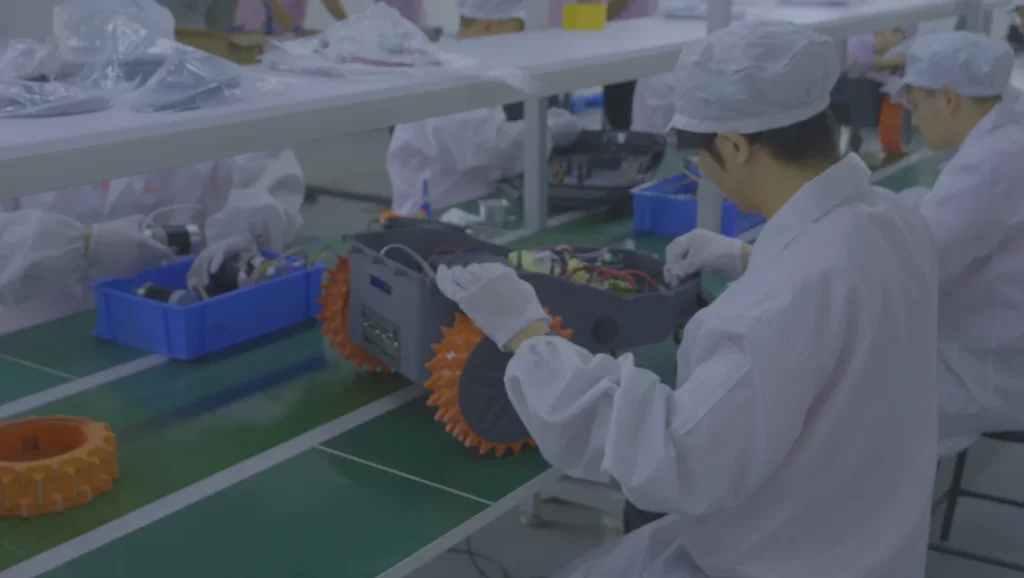
Integrated R&D & Production
End-to-End Business Support

Two wire-free RTK + vision mower platforms for brands, distributors and OPE companies.

BASE-STATION RTK

NETWORK RTK
Recommended lawn range for both RTK robotic mower platforms.
Choose Base-Station RTK or Network RTK for your deployment model.
Sample evaluation, OEM / ODM planning and production qualification.
Both platforms cover the same recommended lawn range. The key buying decision is the correction source, mapping workflow, connectivity and target-market deployment model.
AN3000V · BASE-STATION RTK
A wire-free RTK mower using a local RTK reference together with AI vision and IMU for planned mowing, virtual boundaries and connected lawn management.
Cutting width210 mm
Height adjustmentApp control
ConnectivityBluetooth + 4G
Mow area / charge150–200 m²
Local RTK antenna
Virtual boundary
GPS theft tracking
Multi-zone
DEPLOYMENT PROFILE
For projects that prefer a local RTK correction source and direct control over on-site reference hardware.
AN3000VR · NETWORK RTK
A wire-free Network RTK mower combining NRTK correction, vision sensing and IMU with automatic edge searching and mapping.
Cutting width200 mm
Mapping workflowAutomatic edge search
ConnectivityBluetooth + Wi-Fi + 4G
Mow area / charge120–180 m²
Automatic edge mapping
Virtual + physical no-go zone
Cut-to-edge 50–100 mm
Multi-zone
DEPLOYMENT PROFILE
For markets where Network RTK service coverage and reliable data connectivity can be validated before launch.
Both RTK mower platforms are built around digital lawn setup, planned mowing and connected control.
Define working areas digitally without traditional perimeter wire installation.
Use structured route execution instead of purely random movement.
Manage separate lawn areas inside the mapped property.
Complement RTK correction with onboard perception and motion awareness.
Compare the factors that change installation, product positioning and B2B launch planning.
Decision factor
AN3000V
AN3000VR
RTK correction source
Local RTK reference station near the mowing area
Correction data through a compatible Network RTK service
Mapping & boundary workflow
Virtual boundary · virtual no-go zone · planned route
Automatic edge mapping · virtual boundary · virtual + physical no-go zones
Cutting configuration
210 mm · 30–60 mm · 7 positions
200 mm · 20 / 30 / 40 / 50 / 60 mm
Height adjustment
App control
Button adjustment
Connectivity
Bluetooth + 4G
Bluetooth + Wi-Fi + 4G
Typical mow area / charge
150–200 m²
120–180 m²
Sample-validation focus
Base-station placement · correction stability · boundary repeatability
NRTK coverage · data connectivity · automatic mapping workflow
Shared: 500–3,000 m² recommended range · planned mowing · vision obstacle sensing · multi-zone management · automatic charging · 50% listed slope · 59 dB · IPX5
Plan for base-station placement, GNSS visibility and a workflow that includes local RTK reference hardware.
Validate NRTK coverage, data connectivity, service conditions and automatic mapping performance.
Download model-level technical data for sourcing review, internal comparison and sample qualification.
AN3000V · BASE-STATION RTK
Navigation, cutting system, connectivity, safety and packaging information.
AN3000VR · NETWORK RTK
NRTK architecture, mapping workflow, cutting system and connectivity information.
B2B PROJECT INFORMATION
Ask for sample pricing, MOQ, customization scope and lead-time planning.
Use representative lawns to validate the RTK architecture, navigation behavior, connectivity and service workflow before production approval.
01
Correction availability, recovery behavior and representative GNSS conditions.
02
Virtual boundaries, no-go zones, edge behavior and repeated route execution.
03
Common garden objects, narrow passages and complex layouts.
04
Traction, turning and mowing quality on target-market terrain.
05
Setup, mapping, scheduling, firmware workflow and connection reliability.
06
Return-to-charge behavior, battery workflow, accessories and service requirements.
After sample approval, align the mower platform with your brand identity, software requirements, target market and production plan.
Logo, product color direction, labels, manuals and market-facing packaging.
RTK architecture, approved functions, connectivity and hardware scope.
App presentation, languages and software requirements aligned to project scope.
Specification alignment, documentation, QC and production planning.
A sample-first workflow helps product managers and sourcing teams move from architecture selection to an approved OEM / ODM production configuration.
Target market, RTK infrastructure, expected volume and launch goals.
Test RTK stability, routes, boundaries, obstacles, charging and app workflow.
Confirm hardware, software, branding, packaging and service requirements.
Complete pilot validation and QC, then scale the approved configuration.
Answers for brands, distributors and sourcing teams comparing Base-Station RTK, Network RTK and OEM / ODM mower projects.
Share your target market, expected volume and preferred RTK deployment model. Start with the right sample and technical documents.
Tell Us About Your Project


