
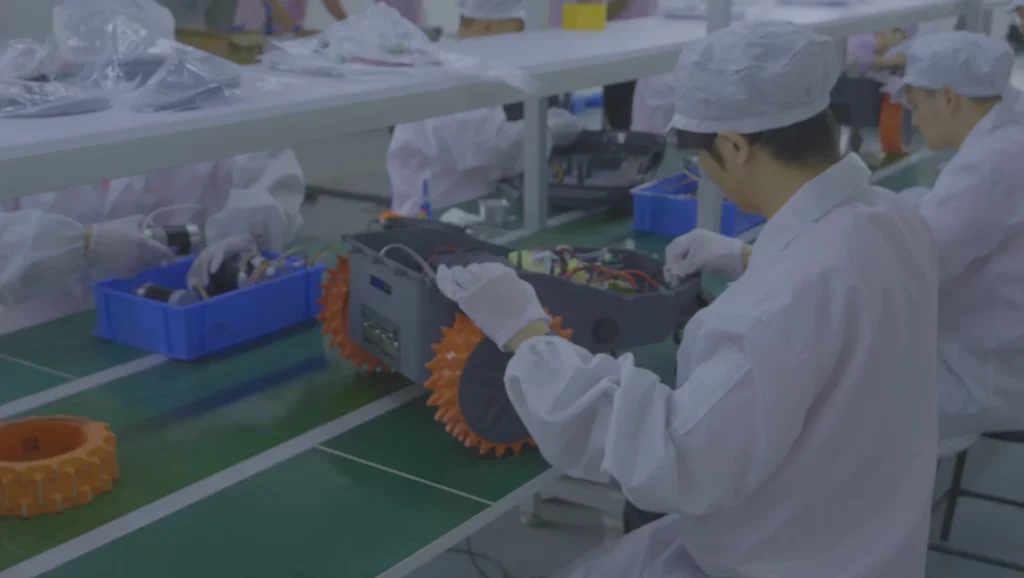








The global robot lawn mower market is rapidly transitioning from traditional perimeter-wire solutions to borderless (virtual boundary) systems. Perimeter wires increase installation costs, reduce layout flexibility, and complicate garden redesigns.
By contrast, virtual boundary robot lawn mowers—also called borderless lawn mowers or wire-free robot lawn mowers—use technologies such as RTK-GNSS, AI vision/SLAM, LiDAR, radar, or hybrid fusion to define mowing areas without any physical wire.
In Europe and North America, more than 40% of newly launched models in 2024–2025 already feature virtual boundary solutions. Asia, especially China, is now the global OEM/ODM hub, supplying both vision-first and RTK-first platforms. The trend is clear: virtual boundary technology is becoming the new standard.
Quick Comparison of Mainstream Virtual Boundary Technologies (with Concrete Lawn Sizes)
| Stack / Technology | How It Works | Typical Lawn Size (m²) | Positioning Accuracy | Setup Needs | Weather/Light Robustness | Cost Level | Best For |
|---|---|---|---|---|---|---|---|
| Monocular Camera (AI Vision + SLAM) | Single RGB camera; boundary detection with AI | 200–1,200 | 8–20 cm | Teach run | Sensitive to low light/rain | $ | Small–mid lawns, simple edges |
| Multi-Camera (Stereo/Surround) Vision | Depth perception with 2+ cameras | 200–2,000 | 5–15 cm | Calibration + teach run | More robust than monocular | $–$$ | Irregular residential lawns |
| RTK-GNSS (Solo) | GNSS + correction signals | 2,000–5,000 (open sky) | 2–5 cm | RTK base/NTRIP setup | Needs clear sky | $$ | Large, open residential/estates |
| RTK + Ultrasonic | RTK plus ultrasonic for edge/obstacle detection | 2,000–5,000 | 2–6 cm | RTK infra + ultrasonic calibration | Works in rain, tall grass may scatter | $$ | Large open lawns needing redundancy |
| RTK + Vision | RTK provides absolute pose; vision confirms boundaries | 400–8,000 | 2–8 cm | RTK infra + camera calibration | Handles partial shade | $$–$$$ | Premium residential, complex edges |
| RTK + 2D LiDAR | RTK global pose + LiDAR edge mapping | 600–6,000 | 3–7 cm | RTK infra + LiDAR mounting | Works day/night; reduced in fog | $$$ | Night mowing, precise edge tracing |
| RTK + Solid-State Radar | RTK global pose + radar edge/obstacle mapping | 600–10,000 | 3–10 cm | RTK infra + radar tuning | Excellent in rain/fog/night | $$$–$$$$ | Large/commercial lawns |
| Vision + Ultrasonic/Radar Fusion (No RTK) | Vision map + local sensors | 200–1,600 | 8–18 cm | Teach run + calibration | Robust to canopy, light-dependent | $–$$ | GNSS-blocked neighborhoods |
| Magnetic/Inductive Strip | Detects buried strip | 400–3,000 | 5–10 cm | Strip layout | Weather-proof | $–$$ + strip cost | Industrial parks, golf courses |
Which Stack Fits What Lawn?
| Lawn Profile | Size (m²) | Sky/Tree Conditions | Edge Complexity | Recommended Stacks |
|---|---|---|---|---|
| Compact urban garden | 200–600 | Buildings/canopy | Simple | Monocular or multi-camera vision |
| Irregular suburban yard | 600–1,800 | Light trees | Complex | Multi-camera vision, Vision+Ultrasonic, RTK+Vision |
| Large open residential estate | 2,000–5,000 | Open sky | Mixed | RTK, RTK+Ultrasonic |
| Patchy canopy corridors | 1,000–4,000 | Partial shade | Complex | RTK+Vision, RTK+2D LiDAR |
| Coastal/foggy or rainy regions | 1,000–10,000 | Mixed | Medium | RTK+Solid-State Radar |
| Night-heavy mowing schedules | 600–6,000 | Any | Moderate | RTK+2D LiDAR, RTK+Radar |
| GNSS-blocked neighborhoods | 200–1,600 | Dense canopy/buildings | Simple | Vision+Ultrasonic/Radar |
| Industrial campuses | 1,000–3,000 | Any | Predictable | Magnetic/Inductive Strip |
How to Use This Table
- If your target customers are homeowners → focus on 200–2,000 m² stacks such as monocular/multi-camera vision or Ecovacs/Worx solutions.
- If your target customers are large estate owners or landscaping services → emphasize RTK-based hybrids covering 2,000–8,000 m².
- If your target customers are hotels, golf courses, or municipalities → showcase RTK+LiDAR or RTK+Radar stacks scaling to 10,000 m² and robust in all weather.
- For OEM/ODM teams: use this sizing as a positioning tool when planning product segmentation and go-to-market strategy.
Brand Reference: Supported Lawn Sizes by Technology
| Brand / Model | Technology | Official Max Lawn Size | Notes |
|---|---|---|---|
| Segway Navimow H3000E | RTK-GNSS | 3,000 m² | Requires RTK base or subscription |
| Husqvarna Automower 450X NERA | RTK + Vision | 5,000 m² | Hybrid, premium residential/professional |
| Worx Landroid Vision L1300/L1500 | Monocular AI Vision | 600–1,200 m² | Vision-only, light-dependent |
| Ecovacs Goat G1-800/G1-1600 | Multi-Camera Vision + SLAM | 800–1,600 m² | Dual fisheye AI, irregular lawns |
| Gardena Smart Sileno Vision | AI Vision + Sensor Fusion | ~1,500 m² | Focused on EU residential users |
| Yard Force NX Series | RTK + Ultrasonic | 3,000–5,000 m² | Edge safety with ultrasonic |
| OEM/ODM (e.g., Altverse Robot Mower) | RTK + LiDAR or RTK + Solid-State Radar | 5,000–10,000 m² | Commercial lawns, golf, hotels |
Notes You Can Add Under the Tables
- Teach Pass Time: Vision-first systems usually require a teach run of 15–40 minutes per ~1,000 m². RTK-first stacks can operate immediately after calibration.
- Antenna Placement: For RTK solutions, mount antennas high and central, away from EMI sources. Poor placement can reduce effective coverage by 20–30%.
- Canopy Rule of Thumb: If sky visibility is below 40–50% for more than 30% of the lawn, favor hybrid (RTK+Vision/LiDAR/Radar) or vision-first stacks.
- Safety Redundancy: Regardless of stack, include bumpers, tilt sensors, child/pet detection, and emergency stop protocols.
- Cost Tiers: From lowest to highest → Monocular Vision < Multi-Camera Vision < RTK ≈ RTK+Ultrasonic < RTK+Vision < RTK+LiDAR < RTK+Radar.
Technology Deep Dive
RTK-GNSS: Provides centimeter-level positioning, ideal for large open lawns of 2,000–5,000 m². Weak under canopy or in urban canyons.
AI Vision (Monocular & Multi-Camera): Monocular supports 200–1,200 m²; multi-camera extends to 2,000 m². Flexible but light/weather dependent.
RTK + Vision: Combines global precision with local edge verification, suitable for 400–8,000 m² and patchy canopy environments.
RTK + 2D LiDAR: Works for 600–6,000 m², strong in night schedules, reduced in fog/rain.
RTK + Solid-State Radar: Supports 600–10,000 m², robust in adverse weather and at night.
Vision + Ultrasonic/Radar: Best for 200–1,600 m² when GNSS is blocked.
Magnetic/Inductive Strip: Transitional solution, reliable for 400–3,000 m² zones but less flexible.
Pros and Cons of Virtual Boundary Robot Lawn Mowers
Pros:
- No perimeter wire, easier installation
- Flexible zoning and reconfiguration
- Works across residential and commercial use
- Smarter navigation and reduced blind spots
- Future-proof with smart home integration
Cons:
- Higher initial cost than wired solutions
- RTK requires base/NTRIP coverage
- Vision-based systems need adequate light
- Some stacks require calibration or teach runs
Frequently Asked Questions (FAQ)
1. What is a borderless lawn mower?
A borderless or virtual boundary robot lawn mower defines mowing zones using RTK, vision, LiDAR, radar, or hybrid fusion instead of a perimeter wire.
2. How accurate are these technologies?
RTK: 2–5 cm in open sky; Vision: 5–20 cm; Hybrid RTK+Vision/LiDAR/Radar: 2–10 cm with better robustness.
3. Which solution is best for small lawns?
Vision-first (monocular or multi-camera) systems are practical for 200–2,000 m².
4. Do RTK systems need subscriptions?
Some require NTRIP correction subscriptions; others include a local base station.
5. Which systems work best under canopy or poor GNSS?
Hybrid RTK+Vision/LiDAR/Radar solutions are designed to handle canopy and urban obstructions.
6. Can borderless mowers operate at night or in rain/fog?
Yes—stacks using LiDAR or radar are robust at night and in poor weather. Vision-only systems perform best in daylight.
7. Are borderless models more expensive?
Yes, but savings in installation and flexibility often offset the higher upfront cost.
Future Trends in Robot Lawn Mowers
Looking ahead, several trends will shape the next generation of robot lawn mower technology:
- Widespread Adoption of Virtual Boundaries – By 2030, almost all new models will be wire-free.
- Hybrid Sensor Fusion Becomes Standard – RTK + Vision + LiDAR/Radar will dominate.
- AI-Driven Smart Navigation – Smarter algorithms for dynamic obstacle handling and safety.
- Integration with Smart Homes and IoT – Connection with weather forecasts, irrigation, and voice assistants.
- Sustainability and Low-Carbon Design – More recyclable materials, efficient batteries, and solar options.
- Commercial-Grade Platforms – Hotels, golf courses, and cities adopting large 10,000 m²+ mowers.
- Autonomous Fleet Management – Coordinated multi-mower systems for landscapers.
- Stricter Regulatory Standards – Safety, AI decision-making, and certification requirements will tighten.
Conclusion: Why Virtual Boundary is the Future
The transition from wired to borderless robot lawn mowers is well underway. With concrete sizing guidelines (200–10,000 m²), modular technology options, and clear future trends, manufacturers and users can find tailored solutions for residential, estate, and commercial lawns.
For OEM/ODM brands, the opportunity is clear: invest in hybrid, AI-driven, and fleet-ready platforms today to secure tomorrow’s market leadership.
Looking for custom robot lawn mower solutions with advanced virtual boundary technology?
👉 Contact us today to explore OEM/ODM partnerships and tailored product development.
Turn Your Robotic Mower Vision Into Production
Custom OEM/ODM manufacturing — PCBA, assembly, and logistics from one partner.
- Fast turnaround from design to delivery
- Trusted by brands across the globe
- Free DFM review before you commit
- Dedicated engineer within 24 hours

Expert in robotics, passionate about exploring a wide range of robots, robots that make work more efficient, exploring robots, including mobile robots, lawnmower robots.


