
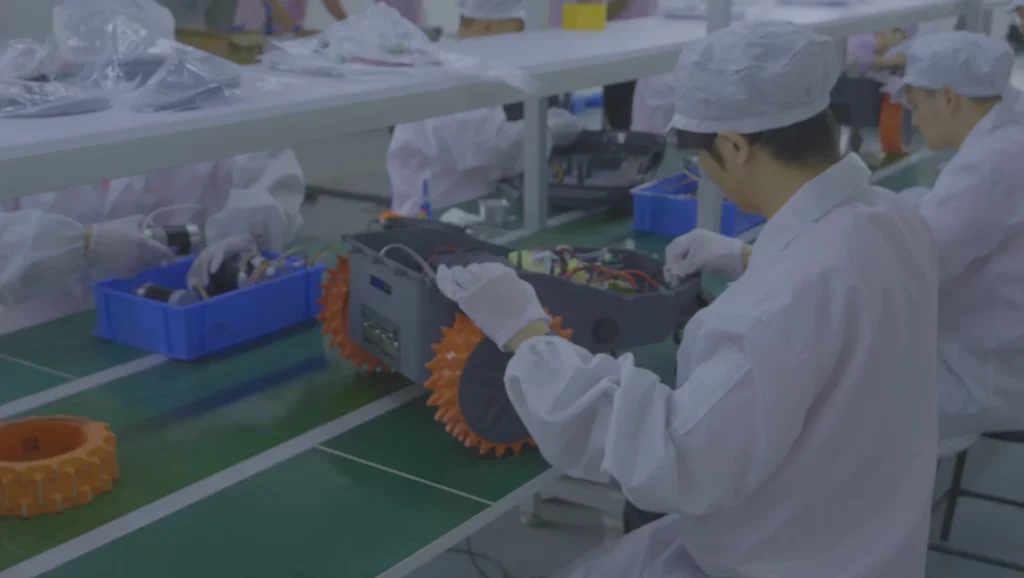








Automatic robot lawn mower, because of the year-round autonomous work outside, want to get a durable robot lawn mower, you need to understand the lawn mower housing materials, housing materials as long as the consideration of weather resistance, waterproof, anti-collision, lightweight and other requirements, the article just to introduce the robot lawn mower housing the use of common materials
Robot Lawn Mower Housing Material Comparison Table – Quick View
| Material Comparison | Characteristics | UV/rain | Cost | Weight | Appearance | Application Grade | Processing |
| ABS | Easy to mold, impact resistant, easy to paint | ★★☆☆☆ (UV coating required) | Low | Light | Easy to color, smooth surface | Entry level | Injection molding, painting |
| ASA | UV-resistant, not easy to fade, impact resistant | ★★★★☆ | Medium | Light | Can keep the color for a long time | High-end | Injection molding, direct coloring without painting |
| PC | Heat-resistant, impact-resistant, high strength | ★★★★☆☆☆ (need coating) | High | Medium | Translucent or transparent colorable | High-end machine | Injection molding, thermoforming |
| PC+ABS | Good toughness, high strength, taking into account the molding properties | ★★★★☆(better with coating) | Medium | Medium | Various colors available, high gloss | High-end | Injection molding, painting |
| PA+GF | Heat-resistant, abrasion-resistant, impact-resistant | ★★★★☆☆☆ (surface treatment required) | High | Heavy | Texture favoring industrial | Highly durable machine | Injection molding |
| Aluminum Alloy | Corrosion resistance, good texture, high strength | ★★★★★ | Very high | Heavy | Metallic texture, high-end appearance | High-end customization | Die casting, CNC, paint |
Enclosure Material Performance and Risks in High Temperature Environments
| Materials | Thermal expansion and deformation | UV Aging | Coating and color fading | High Temperature Protection Recommendations |
| ABS | Deformation may occur above 60°C | Prolonged exposure to sunlight can cause discoloration and cracking of the material surface. | Metallic paints are more likely to lose their color at high temperatures, so it is recommended to use a UV-resistant coating. | Choose ASA or PC+ABS material with UV anti-aging agent, choose light color of shell to reduce heat absorption, and consider adding ventilation structure and thermal insulation coating in ODM/OEM design stage. |
| ASA | Deformation may occur when exceeding 100℃. | Resistant to sunlight, not easy to aging and discoloration | Stable coating, long lasting color | Suitable for use in high temperature environments, can be combined with light color coating to reduce heat absorption. |
| PC | Deformation may occur when exceeding 130°C | Aging and yellowing when exposed to sunlight for a long time | Easy to fade and lose color | Add UV anti-aging agent and surface protection coating to avoid prolonged high temperature and humid environment. |
| PC+ABS | Heat distortion temperature 95℃-110℃ | General UV resistance | Easy to fade | Designed with ventilation and heat insulation measures and UV-resistant coatings. |
| PA+GF | Deformation may occur when the temperature exceeds 150℃. | Prone to aging and discoloration after long term exposure to sunlight | Surfaces usually need to be protected by coatings to avoid discoloration and cracking. | Moisture resistant coatings should be added to avoid prolonged exposure to high temperatures and humidity. |
| Aluminum Alloy | Basically no deformation under high temperature | Metal material, not affected by UV rays, will not age or discolor. | Need to be treated by anodizing or spraying to prevent oxidation and discoloration, high stability of coating | Do a good job of anti-corrosion treatment to avoid oxidation and corrosion in high temperature environments, choose high-quality surface treatment processes (e.g. anodizing). |
Performance and Risk of Housing Materials Under Low Temperature Environment
| Material | Thermal expansion and deformation | Embrittlement and cracking | Coating and color fading | Low Temperature Protection Recommendations |
| ABS | Significant dimensional shrinkage at low temperatures and high coefficient of thermal expansion. | Poor toughness at low temperatures, prone to brittleness and cracking at temperatures below 0℃. | Coatings are generally stable, but may develop fine cracks at extreme low temperatures. | Not recommended for long term use in extreme cold environments, add thicker designs and protective coatings if necessary. |
| ASA | Less prone to deformation at low temperatures than at comparable temperatures | Not easily brittle | Coating is stable, color remains basically unchanged | Suitable for use in cold environments, no special protection required, but avoid violent impact. |
| PC | Significant shrinkage at low temperatures, overall dimensional stability | Risk of brittle cracking at temperatures below -40°C | Coating is stable, no significant change in color | Avoid extreme low temperatures and store in a dry environment. |
| PC+ABS | Significant shrinkage at low temperatures, overall dimensional stability | Lower toughness than pure PC, increased risk of brittle cracking at low temperatures | Coating stability is average, the color may be slightly darkened | It is recommended to consider reinforcing the structure during design to avoid cold shock. |
| PA+GF | Good dimensional stability, low shrinkage | Good toughness at low temperatures, but increased risk of embrittlement after water absorption | Fine cracks may occur in the surface coating | Maintain dry environment and regular maintenance for coating protection. |
| Aluminum Alloy | Low temperature thermal expansion and contraction is obvious, but the overall structure is stable, no deformation. | The metal material is tough and will not be brittle. | Coating is stable, no obvious discoloration. | Pay attention to prevent corrosion caused by condensation in low temperature environment and keep the surface protective layer intact. |
Suggestions For the Use of Robotic Lawn Mower Shell Material Program Through High and Low Temperature Comparison
According to the climate characteristics and temperature changes in different regions, it is very important to choose the appropriate robot lawn mower housing materials.
- Tropical and high temperature regions (e.g. Middle East, Australia, South America):
ASA and PC+ABS materials are recommended for their excellent resistance to high temperature and UV rays, which can effectively resist aging and deformation caused by prolonged exposure to the sun. Light-colored housings with UV anti-aging coatings can further enhance the service life. Aluminum alloy is more costly, but performs well in high-temperature environments, making it suitable for high-end customized models.
- Cold and low temperature regions (e.g. Northern Europe, Canada, Russia)
It is recommended to prioritize the use of PA+GF and PC materials, which are more resilient and less brittle at low temperatures. However, it is important to note that PA+GF is highly hygroscopic and requires a dry environment and regular maintenance of the coating. Aluminum alloys are also suitable for low-temperature environments, with excellent cold resistance and structural stability.
- Regions with large temperature differences (large day/night temperature differences or significant seasonal changes):
Materials with stable coefficients of thermal expansion such as ASA, PC+ABS, and aluminum alloys should be selected, and ventilation and buffer structures should be added to the design to prevent structural damage due to expansion and contraction.
Comprehensive Recommendation
ODM/OEM should combine the climate data of the target market in the design stage, choose materials reasonably and conduct high and low temperature cycling and UV aging tests to ensure the durability and aesthetics of the enclosure.
Contact us for exclusive customized solutions
Want to choose the best housing material for your robotic lawn mower?
Whether it’s hot or cold, we can provide you with professional material selection and customized solutions.
Contact us today for one-on-one technical support and customized design services!
Turn Your Robotic Mower Vision Into Production
Custom OEM/ODM manufacturing — PCBA, assembly, and logistics from one partner.
- Fast turnaround from design to delivery
- Trusted by brands across the globe
- Free DFM review before you commit
- Dedicated engineer within 24 hours

Expert in robotics, passionate about exploring a wide range of robots, robots that make work more efficient, exploring robots, including mobile robots, lawnmower robots.


