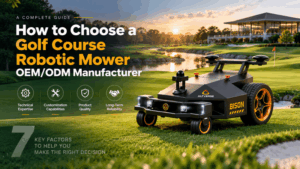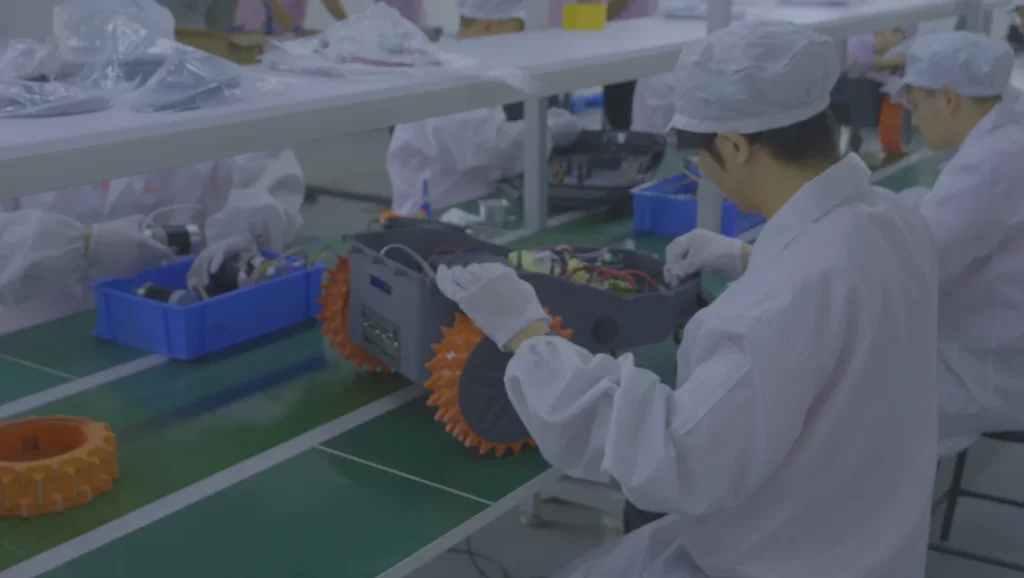


If you are planning to launch your own robotic lawn mower brand, the first question is not which machine to choose. It is who you want to serve, which lawn-care scenarios your product line should cover, and how each model will stand apart.
Too few models may leave important customer needs unmet. Too many can increase development costs, inventory pressure, after-sales workload, and marketing complexity. A well-planned robotic lawn mower product line balances customer needs, lawn conditions, navigation technology, features, and cost to create a portfolio in which each model has a clear role.
This guide follows the practical decisions a new brand needs to make—from understanding users and structuring product tiers to building a product matrix, differentiating models, and validating the lineup before expanding it.
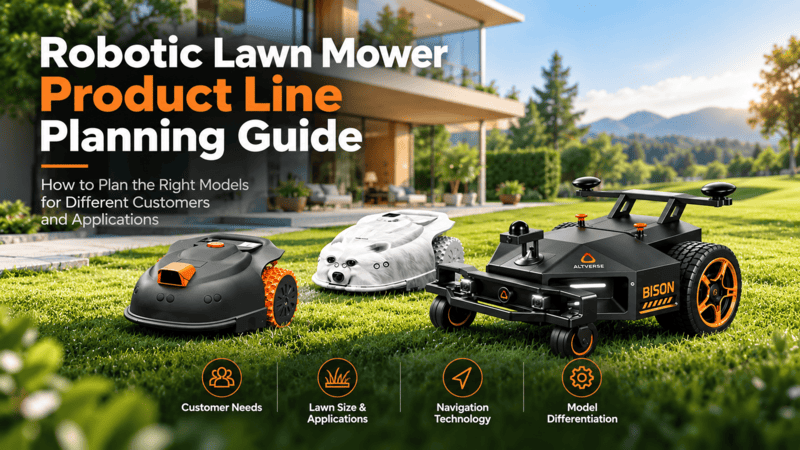
Three Key Terms to Understand Before Planning Your Product Line
- Product line: A group of related products designed for different customers or applications.
- Product matrix: A comparison table that maps each model to its target customer, use case, features, technology, and cost.
- SKU (Stock Keeping Unit): An identifier used to distinguish a specific product or configuration in inventory and sales systems.
In simple terms, product line planning means deciding which products deserve to exist and how they should complement one another.
1. Define Your Target Customers and Lawn-Care Scenarios
Start by identifying who will use the mower, what their lawn is like, and which outcomes matter most to them. For a new brand, focusing on a few well-defined use cases is usually easier to validate than trying to serve every customer from day one.
Look Beyond Lawn Size
Residential customers often care about setup, reliable mowing, obstacle avoidance, noise, app usability, and routine maintenance. Professional landscapers, commercial property managers, and golf-course operators may place more emphasis on operating hours, area coverage per hour, multi-zone management, equipment monitoring, serviceability, and after-sales support.
Lawn size is a useful starting point, but it does not determine the right model on its own. Two lawns of the same area can present very different challenges. A flat lawn with clear boundaries is not the same as a property with dense trees, steep sections, or narrow passages. Those differences can affect the navigation, traction, and sensing capabilities the mower needs.
Create a Simple Customer-Needs Checklist
- Site conditions: Actual mowing area, slope, narrow passages, tree cover, and obstacle layout.
- Operating needs: Available mowing hours, mowing frequency, multi-zone requirements, and remote monitoring.
- Buying priorities: Price, ease of installation, mowing results, convenience, or management efficiency.
- Service expectations: Warranty, spare parts, maintenance, and local support required in the target market.
Once these needs are documented, you can begin to identify which can be served by one model and which may justify a separate configuration. If you are still assessing the market opportunity and entry approach, read this guide to entering the robotic lawn mower market. The focus of this article is the next step: turning confirmed customer needs into a coherent product lineup.
2. Structure Your Robotic Lawn Mower Product Line by Lawn Size and Application
After defining your target customers, decide which product categories your lineup needs. A new brand does not need to launch many models immediately. Start with product platforms that cover the most important requirements, then expand configurations or applications as customer feedback becomes clearer.
The tiers below are examples of a planning approach, not a requirement to create a separate model for every lawn-size bracket.
Small Residential Lawns
Owners of smaller lawns generally want a mower that is easy to install, simple to set up, reliable in daily use, and straightforward to maintain. When planning this type of product, first assess whether the navigation and boundary-handling approach fits the target garden. Then consider obstacle detection, automatic recharging, app control, and maintenance requirements.
More features do not always make a better product. If a feature adds cost or complexity without addressing a meaningful customer problem, it may not belong in the base model.
As one example, the AN500V AI Vision robotic lawn mower is positioned for residential lawns of up to approximately 500 m² and combines AI Vision with an IMU. For a brand planning a small-lawn model, this provides a useful prompt: Is the product’s value easy to explain? Can customers understand the practical benefit of visual navigation? Are installation and everyday use simple enough for the intended audience?
Medium and Large Residential Lawns
As lawns become larger, planning may need to account for positioning conditions, map management, multi-zone mowing, connectivity, and the maintenance workflow. Instead of creating a separate mower for every area bracket, first determine whether an existing platform can cover the need and whether a different configuration would offer meaningful additional value.
Altverse’s RTK Vision robotic mower range illustrates two approaches: AN3000V uses base-station RTK, while AN3000VR uses Network RTK. The product page lists a recommended lawn range of 500–3,000 m² for both platforms. The difference is not just the technology name; it also involves deployment, the source of positioning corrections, and network availability.
This example shows why two models covering a similar lawn area may still serve different needs. Before making them separate SKUs, however, confirm that the target market values the difference and validate it under real operating conditions. A different technical approach does not automatically justify a separate model.
Professional and Commercial Sites
Parks, sports fields, golf courses, and large commercial properties often have requirements that differ from residential lawns. In addition to area, professional users may care about the available operating window, coverage per hour, multi-zone management, equipment status, safety procedures, and maintenance support.
You can review commercial robotic lawn mower solutions and robotic mowing options for golf courses as examples of how professional applications can shape product requirements. A commercial mower should not simply be a larger residential model. Planning should start with the work it must perform, site constraints, who will manage it, and how maintenance will be handled. Confirm the intended area and terrain capabilities against the current product specifications and site conditions.
How Can You Tell Whether Your Product Tiers Make Sense?
- Is the customer clearly defined? Does each tier serve a recognizable customer group and use case?
- Is the difference meaningful? Does each model solve a different problem, rather than differ only in a minor specification?
- Has demand been validated? Is there evidence for the new product or configuration, rather than a desire to cover another lawn-size number?
If two products serve nearly identical customers and needs, first consider whether a configuration change on the existing platform would be sufficient. This helps create a lineup that is clear, complementary, and easier to manage.
3. Choose Navigation Technology and Features for Each Product Tier
Once the product tiers are defined, select the navigation approach and feature set that fit each use case. New brands do not need to master every technical detail at the start. They do need to understand how different options affect installation, operating conditions, cost, and customer experience.
AI Vision: Use Visual Sensing to Understand the Surroundings
AI Vision typically uses cameras and vision algorithms to identify lawn edges, obstacles, and nearby objects, helping a mower plan its route. When evaluating this approach, consider lighting, vegetation, boundary characteristics, and the types of obstacles in the target environment. Validate detection and navigation through real-world tests rather than assuming that “AI” will work reliably in every setting.
The AN500V AI Vision platform is one example to consider when planning a residential mower. A brand should evaluate whether visual navigation can simplify setup, suit the target garden, and perform consistently in the conditions where customers will use the product.
RTK: Choose a Positioning Setup That Fits the Site
RTK is a positioning technique that uses satellite-navigation data and correction information to improve location accuracy. Base-station RTK generally uses a local reference station installed at the site. Network RTK relies on correction data delivered through a network service. The approaches can differ in installation, service availability, connectivity requirements, and user workflow.
When assessing an RTK-based mower, consider both the technology and the deployment environment. Is a suitable Network RTK service available in the target region? Can a base station be installed in an appropriate location? Will these differences create enough practical value for the customer to justify separate product configurations?
Commercial Mowers: Evaluate Navigation, Drive, Safety, and Maintenance Together
On professional sites, performance depends on more than positioning. Slope, ground traction, narrow passages, fixed and moving obstacles, people on site, and the way equipment is managed can all affect suitability.
Commercial product planning should therefore assess navigation and sensing, drive capability, safety systems, charging, remote status monitoring, and after-sales support as a whole. A single sensor or maximum-area figure is not enough to determine whether a mower is suitable for a site.
Four Questions to Ask Before Adding a Technology or Feature
Is the environment suitable?
Does the site provide the lighting, positioning, network, or installation conditions the technology needs?
Does the customer need it?
Will it improve the user experience or operating result in a meaningful way?
Is the cost justified?
Will it add complexity to installation, use, maintenance, or support?
Has the result been verified?
Is there a formal specification, test record, or site result to support the claim?
If the answers are not yet clear, treat the feature as a requirement to validate—not as a confirmed product selling point. The goal is not to put the most technology into every mower; it is to choose technology that solves a defined customer problem.
4. Use a Product Matrix to Define the Role of Every Model
After establishing the product architecture, document the plan in a product matrix. It does not need to be complicated at first. It should make clear who each model serves, what problem it solves, which capabilities address that problem, and how it differs from other products in the lineup.
Example: Robotic Lawn Mower Product Planning Matrix
| Planning Dimension | Small Residential Lawns | Medium and Large Residential Lawns | Professional and Commercial Sites |
|---|---|---|---|
| Target customers | Homeowners seeking simpler routine mowing | Homeowners with larger or more complex lawns | Landscaping teams, site operators, and property managers |
| Core needs | Easy setup, consistent mowing, and simple maintenance | Positioning, mapping, coverage, and multi-zone management | Operational efficiency, site adaptability, equipment oversight, and maintenance |
| Technology to evaluate | Visual sensing, edge handling, obstacle avoidance, and safety | RTK deployment, connectivity, mapping, and zone management | Navigation, drive system, safety, scheduling, and service workflow |
| Example product direction | AI Vision, such as AN500V | RTK Vision, such as AN3000V / AN3000VR | Commercial or golf-course mower platforms |
| Pre-launch validation | Typical gardens, edges, and obstacles | Positioning stability, zone changes, signal conditions, and mapping workflow | Operating windows, terrain, people on site, and service plans |
This table is a planning example, not a full technical comparison of any manufacturer’s products. When building a product roadmap, add verified specifications, target costs, test results, and service requirements. Clearly separate capabilities that have been validated from goals that still need testing.
Four Questions to Check Whether a Model Deserves a Place in the Lineup
- Who is the target user? Are the buyer, operator, and maintenance person the same, and what matters most to each?
- What problem does the model solve? Is the need real and important enough to justify a separate model?
- Why is it different? Can customers understand the value of the difference, beyond a minor specification change?
- Can the business support it? Will the new features create significant spare-parts, training, support, or maintenance burdens?
If a proposed model cannot answer these questions, do not add it to the lineup automatically. First consider whether an adjustment to an existing model or configuration would meet the need. The purpose of the product matrix is to give every robotic lawn mower a clear customer, role, and source of value while keeping the overall portfolio manageable.
5. Differentiate Models and Avoid Unnecessary SKU Complexity
A well-designed robotic lawn mower product line should address different customer needs without creating too many models with similar positioning or overlapping features.
A SKU, or Stock Keeping Unit, is an identifier for a specific product or configuration. Different colors, accessory bundles, navigation options, or market versions may be managed as separate SKUs. More SKUs are not inherently bad, but every added version may increase the work required for forecasting, inventory, after-sales support, and product documentation.
Separate Essential Features from Differentiating Features
Essential features are needed for the mower to perform its core task and operate safely. Differentiating features address a specific user need or provide a clear additional benefit in a higher-tier configuration.
Do not add features merely to make two models look different. For every configuration choice, ask what real problem it solves and why the customer would value it. If a feature increases cost without meaningfully improving mowing, setup, or equipment management, it may not justify a separate model. If customers have genuinely different requirements for deployment, site management, or operating methods, a distinct configuration may make sense.
Check Four Things Before Adding a New Model
- Real demand: Is the proposal supported by identifiable customers, use cases, inquiries, or dealer feedback?
- Clear differentiation: Does the new model solve a problem that existing products cannot reasonably address?
- A need for a separate model: Could the requirement be met by adjusting an existing platform instead?
- Reasonable investment: Is the expected value sufficient to justify development, inventory, maintenance, service, and marketing costs?
Example: Do Similar Lawn-Coverage Ranges Require Two Models?
AN3000V and AN3000VR are an example of how product differences can come from RTK architecture and deployment conditions rather than lawn area alone. However, different technology does not automatically mean that two separate models are necessary. A brand still needs to verify whether customers value the distinction and whether it affects their buying decision. Check the current technical details before drawing conclusions about either platform.
The goal is neither to minimize SKUs at all costs nor to keep adding models. It is to ensure that every model has a clear target customer and a meaningful role, while keeping the overall product line practical to operate.
6. Validate the Product Line Before Expanding It
A planning matrix can support decisions, but it cannot replace field testing. For a new brand, validating a small number of core models against real use cases before expanding the lineup is often a more manageable approach.
Test Performance on Representative Lawns
Do not test only on flat, open lawns. Based on the target market, include relevant boundary conditions, slopes, narrow passages, tree cover, connectivity, mapping, automatic recharging, and routine maintenance. Record the site conditions, product configuration, results, and any failures. Repeat tests where needed rather than relying on a single demonstration.
Use Customer and Dealer Feedback to Check Positioning
Show the product matrix to prospective customers and channel partners. Check whether they understand the difference between models and which features influence their buying decisions.
Instead of only asking whether they like a product, ask:
- In what situation would you use this mower?
- Why would you choose it over another model?
- Which features are useful, and which would you not use?
- What installation, maintenance, or after-sales support would you expect?
Use Evidence to Decide What to Develop Next
If existing models cannot meet a clear and valuable need, assess whether a new model or platform is justified. If the gap involves only a few features and an existing platform can address it at a reasonable cost, a configuration change may be more appropriate.
Expand the product line only after reviewing customer demand, technical feasibility, service capability, and likely return on investment. Product expansion should follow evidence, not a desire to offer more models or cover more lawn-size brackets.
From Product Planning to Implementation
Once the product portfolio is reasonably clear, evaluate whether existing platforms can meet the requirements and which needs, if any, call for customization. Explore the robotic lawn mower product portfolio to compare the product directions currently offered.
If you need to understand sample validation, customization, and production stages, see the OEM/ODM development process for robotic lawn mowers. If your main question is how to bring a product line to market through a manufacturing partnership, this guide to launching a mower lineup through OEM/ODM covers that adjacent topic.
The distinction is simple: product line planning answers “What products should we offer?” Development and manufacturing answer “How do we build them?” Defining the lineup first helps keep later development focused.
Conclusion
A successful robotic lawn mower product line is not the one with the most models. It is the one in which each model serves a clear customer, fits a real application, and offers a meaningful difference. New brands can start with a focused set of core products, use a product matrix to define each model, validate the lineup in the field, and expand only when customer evidence supports the next step.
Planning Your Robotic Lawn Mower Product Line?
Looking to launch or expand your robotic lawn mower lineup? Contact Altverse to discuss your OEM/ODM project and explore the right product solutions for your target market.
Frequently Asked Questions
1. How many robotic lawn mower models should a new brand launch first?
There is no single model count that suits every brand. Start with a small number of products that cover the clearest customer needs and applications. Add models only when feedback or market evidence shows a meaningful gap. Each new model should have a defined target customer and a distinct value proposition.
2. How should a robotic lawn mower product line be planned by lawn size?
Lawn size is a useful starting point, but it should not be the only criterion. Consider slope, obstacles, navigation conditions, mowing capacity, multi-zone needs, and maintenance. Two lawns of the same size may require different configurations because their terrain and operating conditions differ.
3. How should brands choose between AI Vision and RTK robotic lawn mowers?
AI Vision uses cameras and vision algorithms to interpret the surrounding environment. RTK uses satellite-positioning data and correction information to improve location accuracy. The two approaches have different environmental, deployment, and connectivity requirements. Choose based on the target site, customer needs, verified specifications, and field-test results—not on the technology name alone.
4. Should residential and commercial robotic lawn mowers be separate product lines?
Separate product lines are worth considering when residential and commercial customers have materially different requirements for operating hours, site management, safety, maintenance, or productivity. Residential models often prioritize ease of use, while commercial products need to support professional workflows and ongoing equipment management.
5. How can a brand prevent overlapping models and too many SKUs?
Use a product matrix to compare each model’s target user, application, features, technology, and cost. When two models solve essentially the same problem, first assess whether an existing platform can meet the need through a configuration change. Add a SKU only when it serves a validated need and provides distinct value.
6. When should a brand develop a new robotic lawn mower model?
Consider a new model when an important, clearly defined customer need cannot be addressed reasonably by the existing lineup. Before committing, validate demand, technical feasibility, development and inventory costs, after-sales capability, and expected business value.
7. Can a new brand plan a robotic lawn mower product line through OEM/ODM?
Yes. A brand can first assess whether an existing OEM/ODM platform meets its core requirements, then determine whether it needs customization of appearance, features, software, or technical configuration. Before starting, confirm specifications, customization scope, testing requirements, and after-sales support.
Turn Your Robotic Mower Vision Into Production
Custom OEM/ODM manufacturing — PCBA, assembly, and logistics from one partner.
- Fast turnaround from design to delivery
- Trusted by brands across the globe
- Free DFM review before you commit
- Dedicated engineer within 24 hours

Robotics specialist at Altverse with 8+ years of experience in robotic lawn mowers, white-label sourcing, OEM/ODM projects, and smart outdoor automation. She helps global buyers evaluate suppliers, compare customization options, and understand quality control, certifications, and after-sales support.