
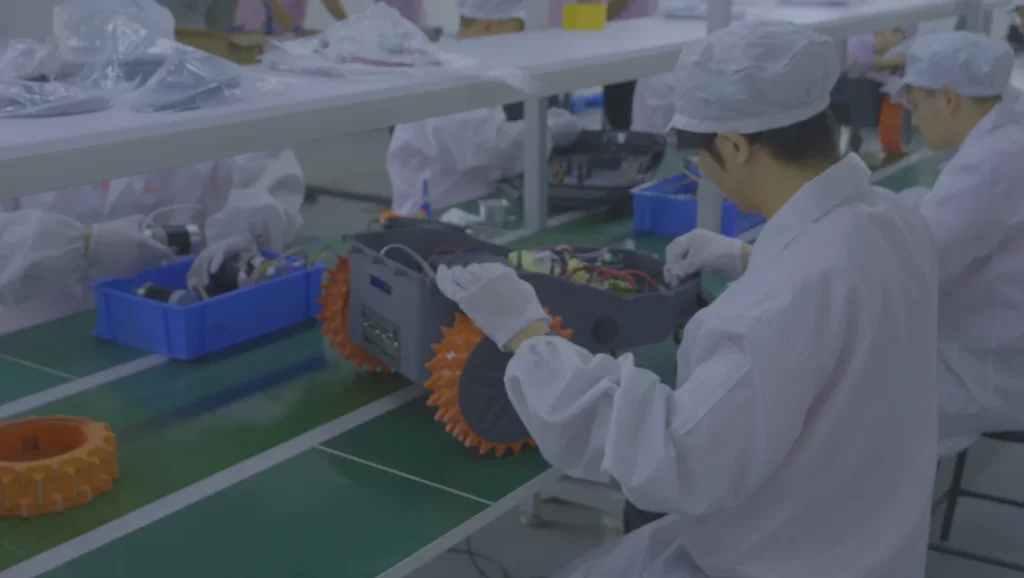


A robotic lawn mower sample that can mow successfully is not necessarily ready for a trial order, and it is certainly not automatically ready for mass production. What B2B buyers really need to verify is whether the sample can complete its tasks reliably in real lawn conditions in the target market, whether abnormal situations remain controllable, and whether the current hardware and software configuration can be replicated in future production units.
For this reason, robotic lawn mower sample testing should go beyond a simple “can it run?” demonstration. The test plan should cover mowing performance, navigation stability, obstacle avoidance and safety, terrain adaptability, battery performance and automatic charging, App and connectivity, and continuous-operation reliability, with clear test conditions and acceptance criteria for each item.

1. Before Testing a Robotic Lawn Mower Sample
Before formal testing begins, first confirm that the sample configuration matches the product you plan to purchase. Key items to verify include the hardware version, main PCBA, battery, drive system, cutting disc, navigation module, sensors, firmware version, and App version. You should also confirm whether any critical components are planned to change before mass production.
For example, if the sample uses GNSS module A but the production version is planned to use GNSS module B, the current RTK high-precision positioning results cannot be used directly as the acceptance basis for the production version. The new configuration must be validated again.
It is recommended to create a Sample Configuration Record for each unit, documenting the key hardware and software versions and linking all test results to the corresponding configuration. This makes it possible to trace performance issues back to a specific version, while also supporting corrective actions and pre-production performance verification.
2. Mowing Performance Test
No matter how advanced the navigation technology is, the final result still depends on mowing quality. A robotic mower sample should not be tested only on a flat, easy lawn. The test should also cover taller and denser grass, as well as more complex areas with trees, flower beds, lawn edges, and narrow passages, so that mowing quality and operating efficiency can be observed under different conditions.
During testing, avoid using vague conclusions such as “mowing performance is good.” Instead, record the actual area mowed, time required to complete the task, number of charging cycles, number of manual interventions, and whether there are missed areas or repeated mowing.
Three Data Points Worth Recording
1. Actual mowing efficiency (m²/h):
For example, on a 500 m² lawn, record the actual mowing time, number of charging cycles, and total task completion time. When comparing different samples, use the same rule for whether charging and waiting time are included in the efficiency calculation.
2. Cutting-height consistency:
Select 20 measurement points across the lawn and compare the target cutting height with the actual result to check whether mowing is even. The allowable deviation should be determined according to the product specification and target-market requirements.
3. Missed areas and edge performance:
Check for obvious uncut areas around flower beds, lawn edges, and narrow passages, and observe whether the mower repeatedly travels over the same path.
These measurements are more useful than simply comparing the claimed “maximum lawn area.” They also make it easier to see real performance differences between robotic lawn mower samples.
3. Navigation and Positioning Test
Wire-free robotic lawn mowers often perform well on open lawns, but real gardens commonly include trees, walls, roof overhangs, fences, and narrow side yards. These conditions can affect GNSS/RTK positioning or vision-based navigation.
At minimum, the test should cover three types of scenarios:
1. Open lawn
Use this as the baseline scenario to observe positioning stability, path planning, and coverage under normal conditions.
2. Areas near trees or buildings
Observe whether satellite-signal obstruction causes route drift, stopping, or positioning errors.
3. Narrow passages or routes connecting multiple zones
Verify whether the mower can pass through successfully, enter the next work area, and return accurately.
Do not test only once. For example, have the sample repeat the same route 10 times and record the number of successful runs, positioning errors, manual interventions, and recovery time. The “10 runs” here is only an example of an internal test design. The key point is to judge stability through repeated testing rather than drawing a conclusion from a single successful run.
For an RTK + Vision robotic lawn mower, also observe what happens when GNSS signals weaken or are lost. Verify whether the robot can use vision, IMU (inertial measurement unit), or wheel odometry to assist localization, whether it slows down or pauses safely, and whether it can continue the original task after positioning is restored. Most importantly, confirm that the mower will not cross the preset virtual boundary when positioning becomes abnormal.
4. Obstacle Avoidance, Safety, and Slope Testing
Obstacles in real gardens vary greatly in height, color, material, and shape. Successfully avoiding one cardboard box only proves that the robot can recognize an obstacle in one simple scenario; it does not represent real-world obstacle-avoidance capability.
Obstacle Avoidance Test
Prepare common obstacles such as a football, flower pot, garden hose, tree trunk, outdoor chair legs, toys, low-profile objects, and stones. Repeat the test from different directions and observe whether the robot identifies the obstacle in time, slows down, and avoids it safely.
For vision-based robotic lawn mowers, add tests under strong midday sunlight, backlighting, shadows, and overcast conditions. Changes in lighting can expose weaknesses in the vision algorithm more easily than a single obstacle test.
Safety Function Test
At minimum, verify collision detection, lift protection, tilt protection, emergency-stop functionality, and blade-stop logic. For tests involving people or pets, use suitable test dummies or models. Do not allow real people or animals to enter the blade-risk area while the mower is operating. On-site sample testing is intended to identify early risks and cannot replace formal safety testing and compliance assessment required by the target market.
Slope Adaptability Test
Do not rely only on the supplier’s claimed “maximum slope.” A robotic mower being able to climb a certain slope does not mean it can mow continuously and reliably on that slope. Test uphill, downhill, cross-slope driving, turning at the top and bottom of slopes, wet grass, and uneven ground. Record wheel slip, heading deviation, boundary crossing, and any need for manual recovery.
5. Battery, Automatic Charging, and App Testing
Rated runtime does not fully represent actual runtime on a real lawn. Grass height and density, slope, cutting-disc load, travel speed, route planning, and temperature can all affect power consumption.
At minimum, complete one full operating loop: 100% battery → mowing → low-battery return → automatic docking → charging → task resume. Record actual mowing time, docking success, charging time, and task-resume performance.
Automatic charging should not be judged by a single successful docking attempt. For internal evaluation, you can arrange 10–20 consecutive docking tests and record the number of successful returns and the causes of any failures. This number is only an example of a test plan and is not a universal industry standard.
App testing should simulate the complete workflow of a new user: download the App, register an account, add the device, connect it to the network, create a map, set virtual boundaries and no-go zones, and start a mowing task. Also test Wi-Fi/Bluetooth interruptions, robot reboot, App closure, OTA updates, and abnormal recovery to confirm that the user can return to normal operation after a problem occurs.
6. Reliability and Continuous Operation Testing
A sample that performs well during a 20–30 minute demonstration is not necessarily capable of stable long-term operation. Some problems only appear after continuous mowing, repeated automatic charging, repeated map-based tasks, or an abnormal shutdown.
Before sample acceptance, it is therefore recommended to arrange an extended operating test, such as running the mower continuously for several hours per day over multiple days, or completing multiple full mowing and charging cycles.
During the test, focus on recording stuck events, manual interventions, navigation errors, docking failures, App disconnections, abnormal restarts, cutting-disc errors, and sensor faults.
If the same problem occurs repeatedly, the sample should not be accepted simply because the supplier says “the next software version will fix it.” Require the supplier to close the issue through a complete process: Issue → Root Cause → Corrective Action → New Version → Retest → Closed. Critical problems affecting safety, navigation, or normal mowing should be retested and closed before moving to the next procurement stage.
7. Robotic Lawn Mower Sample Acceptance
After testing is complete, do not use “overall, it feels good” as the final conclusion. Procurement, R&D, and quality teams should review the same auditable Sample Acceptance Sheet.
Each test item should include the test method, actual result, project requirement, and final status so that different teams can make procurement decisions using the same criteria.
Sample Acceptance Sheet Example
| Test Item | Test Method | Recommended Metrics to Record | Acceptance Basis | Status |
|---|---|---|---|---|
| Mowing performance | Target-lawn field test | m²/h, missed areas, cutting-height range, manual interventions | Mutually confirmed product specification | PASS/FAIL |
| Navigation and positioning | Repeated tests in open, obstructed, and narrow areas | Successful runs, abnormal events, recovery time | Target-scenario requirements | PASS/FAIL |
| Obstacle avoidance and safety | Multiple obstacles and multiple approach directions | Detection, avoidance, collision, safety-protection results | Product specification and applicable standards | PASS/FAIL |
| Slope performance | Uphill, downhill, and cross-slope tests | Slope angle, wheel slip, heading deviation, recovery count | Claimed capability and project requirements | PASS/FAIL |
| Battery and charging | Complete mowing-to-charging cycle | Actual runtime, docking success rate, charging time | Mutually agreed targets | PASS/FAIL |
| App and software | First-use workflow + abnormal scenarios | Connection, mapping, OTA, fault recovery | Project requirements | PASS/FAIL |
| Continuous operation | Multi-hour / multi-cycle operation | Faults, restarts, stuck events, manual interventions | Project acceptance criteria | PASS/FAIL |
The specific pass criteria should be agreed before testing begins by the buyer and supplier based on the product specification and target market.
Recommended Acceptance Results
- PASS: The sample meets the pre-agreed acceptance requirements and can move to a trial order or the next validation stage.
- RETEST: There are fixable issues. The supplier should implement corrective actions and provide a new version for retesting.
- BLOCKER: There is a critical safety issue, core-function defect, or other unacceptable risk. Project progression should be paused.
Passing the sample test only means the project is worth moving to the next stage. It does not mean that the next 100, 500, or 1,000 units will naturally deliver the same performance. Before mass production, specification freeze, pilot-production validation, critical-component consistency checks, and production quality control are still required.
Final Checklist: What Else Should Be Confirmed Before Placing a Trial Order?
- ☐ Sample hardware and software versions have been recorded, and it has been confirmed whether they represent the subsequent version.
- ☐ Mowing efficiency, cutting-height consistency, missed areas, and edge performance have been tested.
- ☐ Navigation tests have covered open lawns, areas under trees / near walls, and narrow passages.
- ☐ Recovery behavior after RTK or network abnormalities has been verified.
- ☐ Multiple obstacle types, approach directions, and lighting conditions have been tested.
- ☐ Lift, tilt, emergency-stop, and other safety protections have been verified.
- ☐ Uphill, downhill, cross-slope, and wet-grass traction have been tested.
- ☐ Actual runtime, automatic docking, charging, and task resumption have been validated.
- ☐ First-time App use, networking, mapping, OTA, and abnormal recovery have been verified.
- ☐ Continuous-operation testing has been completed, and all repeated issues have a corrective-action closure.
Conclusion
For B2B buyers, robotic lawn mower sample testing is not only about checking whether the machine works normally. It is also an important step for evaluating product performance, the supplier’s technical capability, and mass-production risk.
By testing in real-world scenarios, repeating critical tests, and setting clear acceptance criteria, procurement teams can identify potential issues earlier and reduce the risks of trial orders and bulk purchases.
Looking for a Robotic Lawn Mower OEM/ODM Partner?
Altverse supports RTK, AI Vision, RTK + Vision, and commercial robotic mower OEM/ODM projects for brands, importers, and distributors.
Share your target market, requirements, volume, and launch plan, and we’ll help match the right sample configuration.
FAQ
How many robotic lawn mower samples should be ordered before bulk purchasing?
When conditions allow, it is recommended to order at least two samples so they can be cross-tested in the same environment. This helps determine whether an issue is an isolated unit failure or a product-level defect. More samples may be needed if different navigation configurations are being compared or if long-term reliability testing is planned. The exact quantity should be determined according to the project budget and test scope.
How long does robotic lawn mower sample testing usually take?
There is no universal testing duration. It depends on the test scope, lawn conditions, and product maturity. Buyers can reserve 1–2 weeks for an initial test plan to complete basic performance evaluation and multiple full mowing and charging cycles. If navigation problems, software faults, or other issues require corrective action, additional time should be allowed for retesting.
How can robotic lawn mower samples from different suppliers be compared fairly?
Test samples from different suppliers under the same lawn, weather, and task conditions, using the same test items and acceptance criteria. In addition to mowing quality and navigation performance, record the number of manual interventions, problem-solving efficiency, and technical-support performance. Avoid making a procurement decision based only on product specifications or a single demonstration.
Is it necessary to test robotic lawn mower samples on different grass species?
If the product will be sold in markets with significantly different lawn conditions, it is advisable to test representative grass species. Differences in grass density, blade toughness, and growth characteristics can affect cutting load and final mowing quality. Buyers should prioritize grass types that are common in the target market rather than increasing the number of test varieties without a clear reason.
Can a bulk order be placed immediately after the robotic lawn mower sample passes testing?
Passing the sample test does not guarantee that mass-produced units will perform identically. For a new product or customized project, a small pilot production run is recommended to further verify assembly quality, consistency of critical components, and production test procedures before deciding whether to increase the purchase volume.
How can you ensure mass-produced robotic lawn mowers remain consistent with the approved sample?
After sample acceptance, confirm the product specification and critical configuration, and establish a formal version and change-management process. During mass production, the supplier should keep records of critical components, firmware versions, and production-test results. Any major change that may affect product performance should be reassessed and confirmed according to the agreed process.
Turn Your Robotic Mower Vision Into Production
Custom OEM/ODM manufacturing — PCBA, assembly, and logistics from one partner.
- Fast turnaround from design to delivery
- Trusted by brands across the globe
- Free DFM review before you commit
- Dedicated engineer within 24 hours

Robotics specialist at Altverse with 8+ years of experience in robotic lawn mowers, white-label sourcing, OEM/ODM projects, and smart outdoor automation. She helps global buyers evaluate suppliers, compare customization options, and understand quality control, certifications, and after-sales support.


